

Adapted from the Story of the Prodigal Son in Luke 15:11-32
Five years have passed, and I lie in bed and still smell the stench of the pigsty clinging to my memories. Is it seeped into my skin and hair, or has it just settled into my very soul?
I still wonder what Abba must have been thinking when he embraced me as I stumbled down that dusty road the day I returned from my rebellion. Was it the smell of disqualification from my tribal identity? Or was it the smell of a prodigal who had returned to his original place among a forgiving and loving family?
Not only had I fed and touched the pigs, making me unclean and restricted in my proximity to Adonai, but they had fed me! My daily bread was leftovers from the very animal that my people and Adonai considered unclean. What could be worse? I had found the bottom of the pit of despair.
My pursuit of independence and success wasn’t supposed to end that way.
I can still remember the day I walked into his chamber and demanded my share. The words felt hopeful and promising coming out of my mouth: “Father, give me my portion of the inheritance.” I didn’t stutter. I didn’t flinch. I looked him straight in the eyes, assuming that I knew best. Pridefully declaring that I would make my own way. That I was destined for more than the small world of family farms and Jewish custom.
He didn’t argue.
That’s what haunted me most during that dark journey of rebellion. He didn’t rage. He didn’t lecture. He simply nodded, walked to his strongbox, head hung low, and began counting out gold and silver coins. The silence in that room was deafening. But just under the surface, if I had loved him for who he was, I would have heard his heart shatter. I was too deafened by the intoxicated promise of freedom to notice.
Freedom!
Freedom?
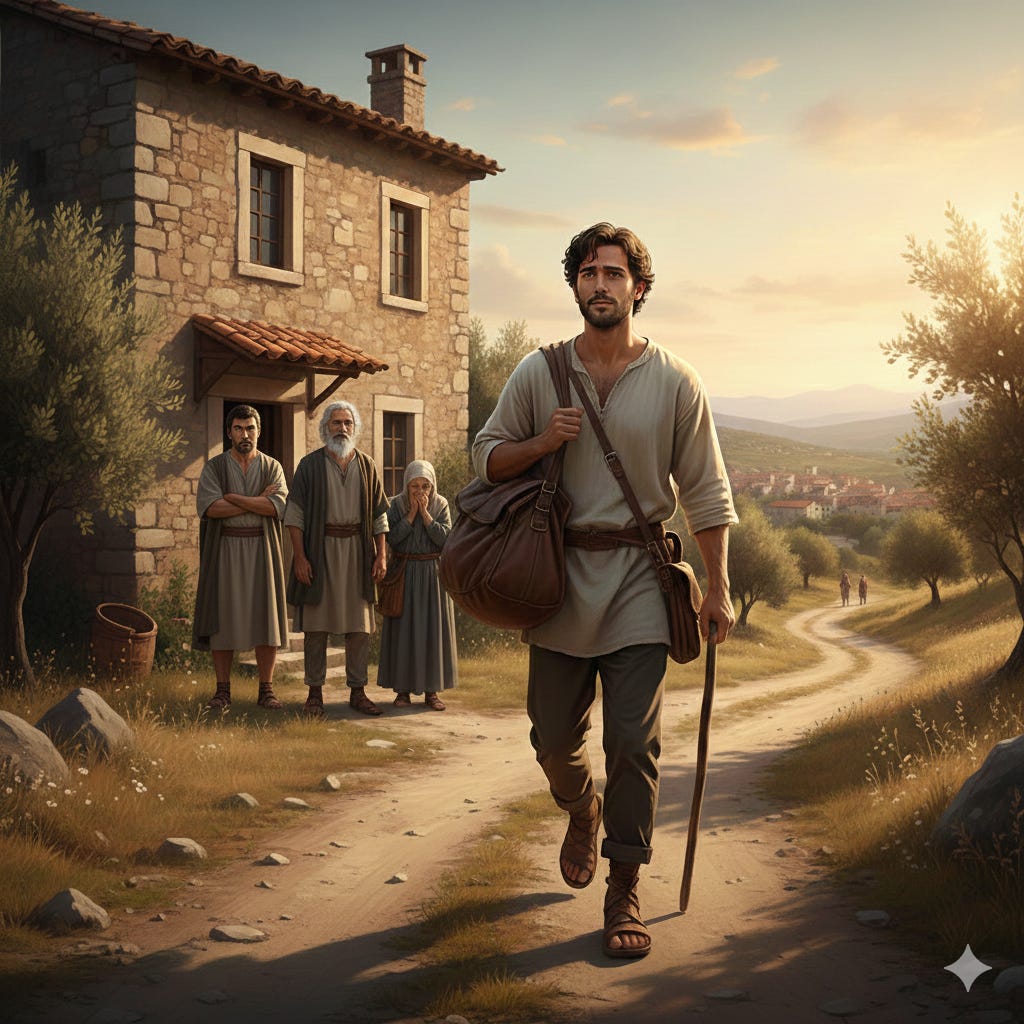
What a lie. I believed that the REAL story would begin as I strutted past the tree-lined border of my father’s land. I was convinced that his rules, his expectations, his watchful eye were chains that bound me to a life half-lived. Out there, beyond the limits of small vision and family ties, THAT was where adventure and unlimited potential awaited.
So I gathered everything and walked away without looking back. If I had turned around, I might have seen him standing in the doorway watching me fade into the seemingly irresistible temptation of independence. I might have seen the tears streaming down his weathered face as he had to release me in order for me to land in the pigpen to recognize that what I was leaving was all I ever really wanted. I might have recognized that his hands were shaking like a leaf as he forced himself to let go. The safety and security of my loving Abba was all I needed to fill the gaping hole in my heart, but I wanted MORE!
I didn’t turn around. I was already emotionally and mentally down the road long before my foot took the first step that led to a season of rejecting what Father provided. And chasing what I thought I could attain through my own ingenuity and strength.
The far country welcomed me with open arms. They were arms that I later learned were reaching for the wealth of my Father’s labor, not the desire of what I had to offer. The wine flowed freely. The so-called friends raised their cups to my generosity night after night. “To the young master! May his fortune never run dry!” I thought those voices were far sweeter than the sweetest wine flowing from the deepest well. They seemed to warm my soul as I silenced the voice that warned that these accolades were rewards for an honor I did not deserve and the result of a lie I would not expose.
But fortunes always run dry. Especially fortunes spent on things that evaporate with the late-night hedonism and early morning hangovers of rebellion.
The hopeless destitution came like a swift current of a raging river, revealing the false identity I was proclaiming with lies of my rebellion. Like a smoke of Father’s pipe wafting into nothingness into the thin air on a cool evening, the inheritance was gone!
I knocked on door after door, begging for any work. I was desperate enough to do ANYTHING. Shopkeepers laughed in my face. The very friends who had drunk my wine suddenly couldn’t remember my name. Those who promised to return the favor turned their backs on my desperation. Every time I was rejected, the feeling Father must have felt when I collected my coins became more tangible to me as I remembered the look of devastation in his eyes the night of my perceived liberation.
Alone.
Hungry.
Invisible.
The gnawing emptiness in my stomach. The nights I’d spent shivering under a bridge trying to stay dry. The realization that pride doesn’t fill a belly. All the pain of wallowing in the hopelessness of my “freedom” led me to the door on which only the most disqualified knock. My head was held as low as I walked up the dusty road that led to the pagan pig farmer. Jews like me would add an hour to their journey to avoid nearing this farm in order to minimize the risk of becoming unclean. Somehow, our religious scruples take low priority when our bellies are screaming hunger and our aching bodies are begging for a place to sleep.
“Please,” I begged. “I’ll do anything.”
He looked me up and down with disgust. A Jew, willing to tend pigs?
Without a word, he thrust a staff into my hands and pointed toward the swine wallowing in the mud. “You really are desperate, you loser! Anyone as desperate as you will do. Even if you can’t work, I’m willing to pay for the joy of seeing one of your kind walking around smelling like swine.”
And there I went. Down into the muck. Down into the pit of my own making.
The pigs lived better than I, feasting on food that satisfied their standards. I watched them devour those carob pods, husks that even the poorest considered less than food, and my mouth watered. I reached for the trough once when no one was watching. The food that I once would have considered trash to a lowly slave now became a feast for a lost soul.
That is what I had become.
A Jewish son with the promise of succession over a portion of my father’s empire, now fighting pigs for scraps and spending my evenings alone. I dreamt of only one who would love me for who I was. And there I found myself, scavenging garbage for bread. Longing for the comforts that I recently turned on in order to make my own way and write my own story.
Is this the best story I could write?
One evening, as the sun set over that wretched place, I collapsed against the fence post. My ribs pressed against skin that hung too loosely from the hunger that lingered like a dark cloud over my hopeless state.
And I wept.
These tears came from somewhere deep. They came from the place where a man finally stops running from the truth. Memories flooded in that I’d been drowning out with wine and distraction as long as I had the money to hide. My father’s hands, strong yet gentle. His voice, firm but laced with love. His table, overflowing with food, where even the servants ate better than this.
The servants.
The thought hit me like a lightning bolt. My father’s hired hands had bread to spare! And there I was, his own son, starving and stinking among swine. Maybe I could go back. Not as a son, for I had forfeited that right. Could I return as a hired hand?
Anything was better than the pigstys.
As I left the pigs, I heard the owner laughing out loud. “Good riddance,” he shouted, “You lasted longer than I expected, and it was worth every minute you slept in my barn, vagabond.”
I rehearsed the speech as I walked. Day after day, step after agonizing step.
“Father, I have sinned against heaven and against you. I am no longer worthy to be called your son. Would you, no, could you make me like one of your hired servants? I will do anything you ask.”
But it wasn’t the speech that terrified me. It was imagining his face when he saw me. Would he turn away? Would he bar the door? Would he send me on down the road? Every imagined scenario ended in rejection. It would be the final confirmation that I had burned a bridge that could never be rebuilt.
I deserved whatever scorn awaited.
But still, I walked. Because dying on that road, moving toward home, felt nobler than dying in that pig pen, sleeping in that mud, and accepting an identity that made me an outcast.
The familiar hills came into view. Then the olive groves where I used to play. Then the roof of the house. My legs felt like sand. My feet wanted to turn 180 degrees and begin to run as far away as I possibly could. I stopped at the crest of the final hill, frozen between the pull of hope and the push of shame and hopelessness.
And then I saw movement near the house. A figure emerged from the front gate. Distant at first. But something about the way he moved seemed urgent. Almost frantic.
The figure began to run.
No.
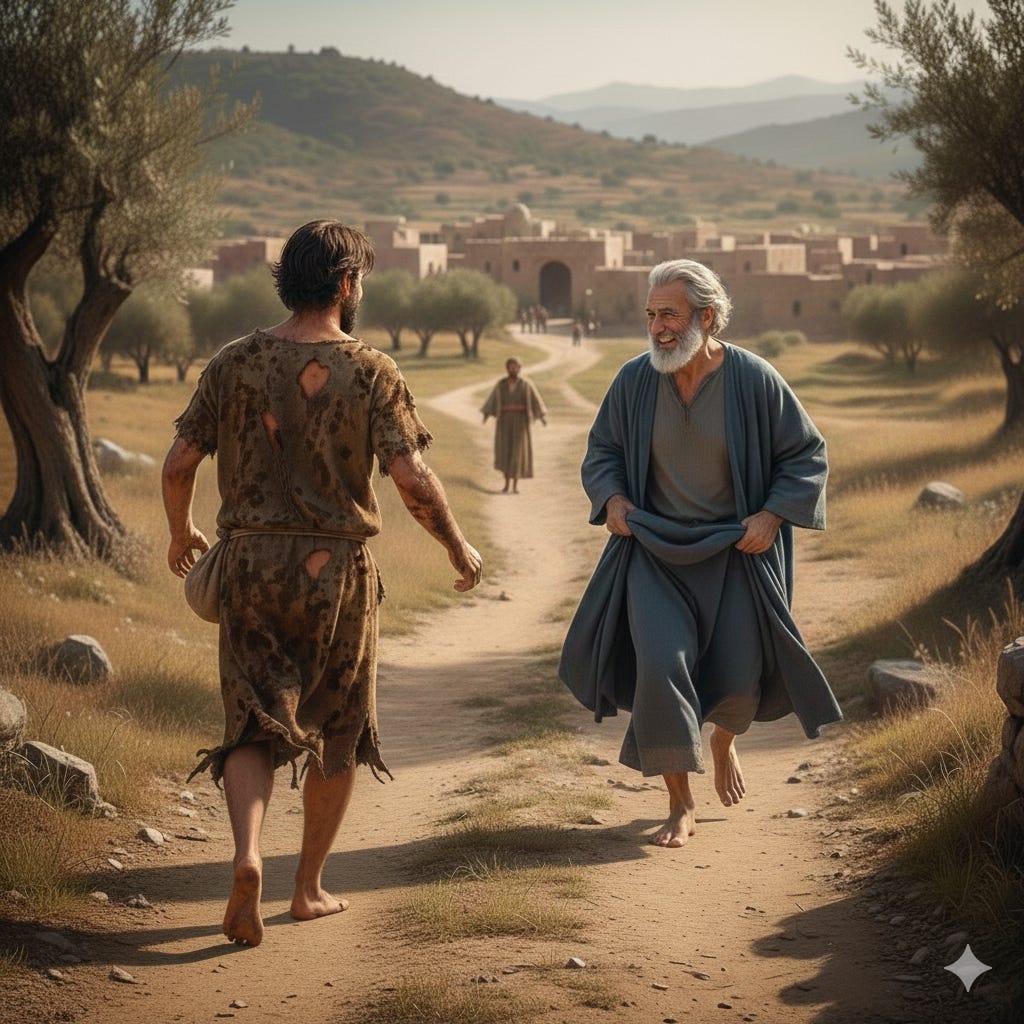
An older man, running? That wasn’t right. It wasn’t dignified. Elders don’t run. They walk with measured steps, proving that nothing is beyond their control. Running was for children. For servants. Not for masters of estates. And certainly not for patriarchs or elders!
But this man was running.
Sandals kicking up dust. Robes gathered in his fists. Arms swinging. Beard flowing.
Father?
He should have been inside, waiting to receive my apology from a seat of judgment. Planning his punishment and scorn. He should NOT have been running toward me as if I were worth his excitement and his embrace.
But he was.
And then he was upon me. His arms crashed into my frail body and wrapped around me so tight I thought my ribs might crack. His sobs were loud and unashamed. His tears were wet on the side of my face. His oiled and cared-for body touched my dry, smelly skin.
“My son. MY SON! You’re home!”
I tried my rehearsed speech. “Father, I have sinned against heaven and against you…”
He wasn’t listening. He was shouting instructions even as he held me.
“Quick! Bring the best robe! Bring a ring for his finger! Sandals for his feet!”
“I am no longer worthy to be called your son…”
He pulled back and looked at me. His eyes took in the hollowed cheeks, the matted hair, the smell of the pigsty proclaiming that I was unclean and a humiliation to my family.
And he smiled!

“This son of mine was dead and is alive again. He was lost and is found!”
He wasn’t hearing my confession because he didn’t need it. He didn’t see a disgraced failure who deserved to be a servant.
He saw his son.
And he ran to him despite the pig dung and the stench of failure.
I collapsed against his chest and wept. The tears weren’t from hunger or self-pity. They were the tears of a man who had prepared for wrath, but received an embrace. Who had braced for justice and was flooded with mercy. Who had prepared for legalistic punishment, but received radical kindness and love. Who had rehearsed a request to be a servant and was restored to sonship.
I’m sitting now in the comfortable bedroom of my youth. The robe they placed on my shoulders hangs in the corner as a symbol of the overflowing expression of Father’s love and grace. I can’t bring myself to wear it yet. It feels too clean for what I’ve done. I slowly look down at the ring that sits heavy on my finger, a constant reminder that I belong here even when everything inside me screams that I don’t.
The journey home wasn’t just about returning to a place. It was about returning to who I was always meant to be. It was symbolic of a redemption I didn’t deserve and love I didn’t earn. I learned in that pigpen what I couldn’t learn in my father’s house: my worth will never be based on what I possess or earn.
It is not based on WHO I AM, the rebellious son of a forgiving Father. No! Not on WHO I am, but on WHOSE I am.
I am the son of my loving Father.
That truth sent him running before I could speak the first word of my rehearsed repentance. That truth covered my shame with the finest robe and sealed my identity with the family ring.
I still lie in bed and smell a remnant of pig stench. Whether it’s real or ingrained in the memory of the rebellion, I do not know. But I don’t resent it anymore. That smell is a monument to the unreasonable and unlimited grace of my loving Father.
I was dead, and I’m alive. I was lost, and I’m found. I was wallowing in rebellion, and now I’m a recipient of the love of an unimaginably gracious Father.
"I was too deafened by the intoxicated promise of freedom to notice." The prodigal didn't leave because the father was harsh. He left because he believed the real story was somewhere else. So many men are chasing a "somewhere else" that doesn't exist while ignoring the role they play as a supporting character in God's story. Thanks for sharing this, Kevin.
So touching! Excellent.