

Adapted from John 8:1-11 - The Woman Caught in Adultery
“When they kept on questioning him, he straightened up and said to them, ‘Let any one of you who is without sin be first to throw a stone at her.’...Jesus straightened up and asked her, ‘Woman, where are they? Has no one condemned you?’ ‘No one, sir,’ she said. ‘Then neither do I condemn you,’ Jesus declared. ‘Go now and leave your life of sin.’” — John 8:7-11
Told from the perspective of the adulteress
If there was ever anyone in the history of creation who had the right to condemn me to die, it was Jesus, the Christ.
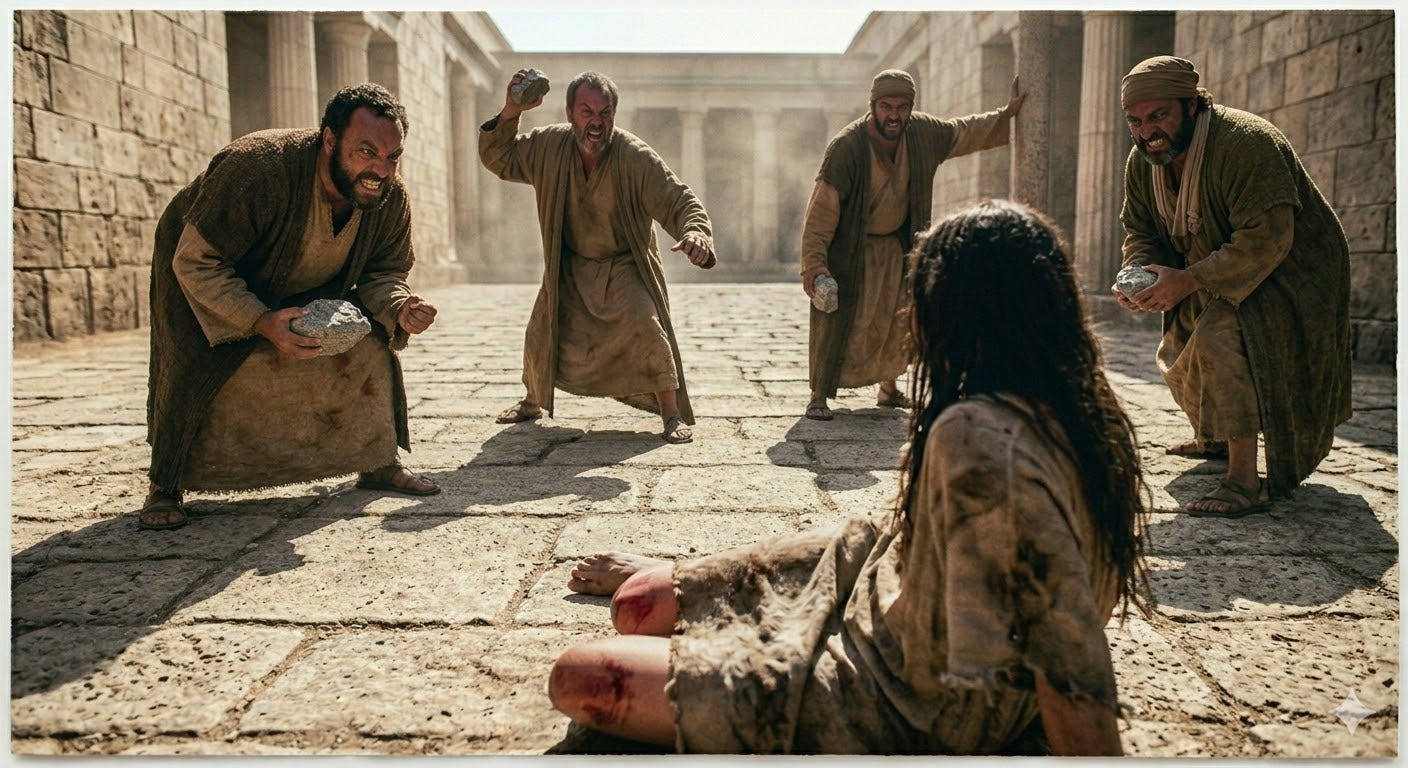
And although those men didn’t earn it with their sinlessness, as He did, those angry religious hypocrites towering over my limp body had the right by Law. I was stretched across that hard cobblestone roadway with knees bleeding from the fall. It seemed inevitable that they’d stone me to death and demand lifeblood for my sin against the Most High God.
I deserved to die, not only by the letter of the Law, but because I had spent my years slowly killing myself with my own choices. One dreadfully bad decision at a time. One compromise after another. Morning after morning, waking up in the wrong place next to the wrong person. Each time, telling myself again that this was simply who I was now. That the girl I used to be, the one who had dreams and a name people loved to love, was too far gone to find her way back.
That’s what shame does, if you let it run long enough. It stops being something you feel and starts being someone you are. It hijacks your identity before you even know you’re in danger.
I had embraced my own shame and claimed it as my unspoken name. I had worn it like a second skin for so long I couldn’t tell where it ended and I began.
The hollow place inside me had been growing since the world made clear, in the way the world does, what kind of woman it had already decided I would become. And somewhere along the way, exhausted from fighting an identity I didn’t choose, I stopped fighting.
When they came pounding on his door that morning to drag me out, I knew they had been waiting for an opportune time to execute their “justice”. It was too early in the morning to have been unplanned. They had been watching as I made my way to his quarters in the cover of darkness the night before. They knew that early in the morning, the traffic in the courtyard would be ideal for parading me through the streets as their latest show pony, playing puppet to their power.
They grabbed my arm. My tunic tore at the shoulder. I stumbled forward into the street, then into the crowd, then into the temple courts, and then that cobblestone came up fast, and my knees hit the rock. The pain shot through me like a declaration.
This is where it ends, I thought.
There is a particular tone that the voice of religious fury takes. I’ve heard it before. The hatred is dressed in the language of righteousness, but underneath it reeks of something else entirely.
Control?
Maybe.
Fear?
Maybe it’s a desperate attempt to make someone else more guilty than the mob.
“Teacher! This woman was caught in the act of adultery!”
In the act. They wanted to make sure everyone understood. They wanted the picture in every mind. They wanted my humiliation to be as complete as possible before the stones were thrust toward my brow. Their words were a much more ferocious projectiles than those jagged stones.
“The Law of Moses commands us to stone such women. What do you say?”
I pressed my palms flat against the ground. I kept my eyes down. I waited.
And then, NOTHING.
Not the nothingness of silence as a criminal awaits the judge’s verdict. Something stranger than that. A nothing that rang louder than the warning bell that sounds a prisoner’s escape. I could feel the crowd shifting. The figurative knife’s edge of the Pharisees’ certainty seemed to soften, somehow.
I looked up.
He was crouched down, writing in the dust with His finger.
Just writing.
As if the most urgent matter before Him was whatever His hand was sketching in the sandy surface of the temple floor. The Pharisees pushed again, louder, more insistent. Their voices had taken on the edge of men who expected an answer to their demands.
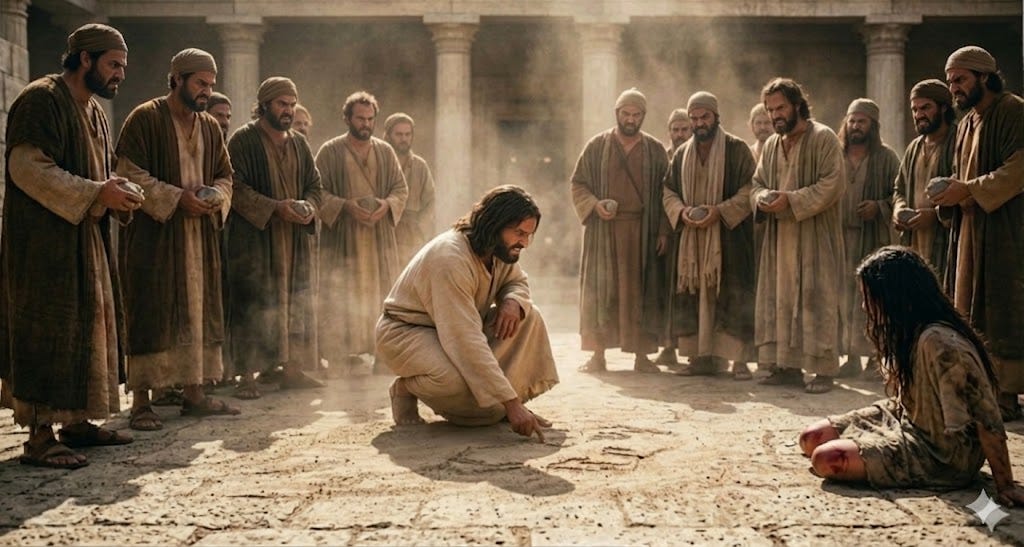

He stood slowly, and His eyes shifted almost lazily toward me. And then His compassionate eyes changed as they turned toward them. And the courtyard went so quiet I could hear my own breathing.
“Let any one of you who is without sin be first to throw a stone at her.”
And then He bent back down.
And kept writing.
He started where He left off and just continued to write. Like the outcome was settled. Like He had already seen the end of this and found nothing in it worth worrying about. The calm of it was almost more startling than the words.
I watched it happen one man at a time. The oldest first, I’ve always been fascinated by that wisdom that was enough to make a man hear what the younger ones could not yet receive. They turned. Their sandals scraped against the stone.
And then the next.
And the next.
And the stones dropped, not thrown, just dropped to the ground with a small thud that sounded like the proclamation of a verdict.
The crowd peeled away. The noise thinned to a murmur and then to quiet.
Until it was only Him.
And me.
Quiet and alone, face-to-face in that courtyard that felt like a torture chamber. It should have been the den of my execution, but it became the place of my unearned favor.
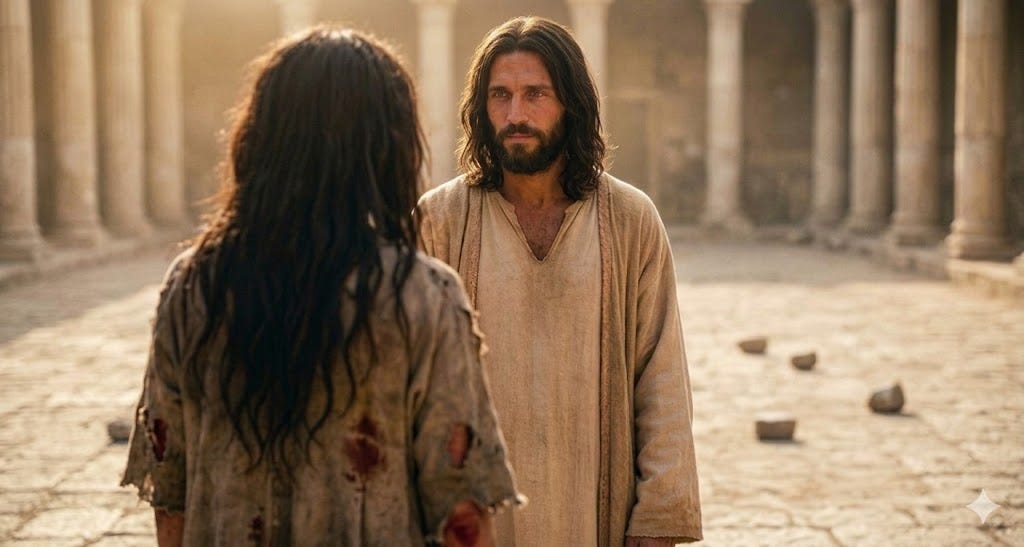
He stood up again, slowly, and looked at me.
Looked at ME.
Not at the outside of me, but the heart of me. Not at the woman they’d dragged in from the street. Not at the category or the verdict or the sum total of every wretched decision that had led to that particular Tuesday afternoon drama. He looked at me like I was a person. Like I was the ONLY person in the entire nation.
I was not ready for that.
I had been prepared for condemnation. For the public proclamation of my failures. The remembrance of my identity as an outcast. For the long list of everything I had done and everything I had become. I had rehearsed my guilt on the way across the courtyard. I had made my peace, or something that passed for peace, with what was coming.
I was not prepared to be seen. I was expecting to be dismissed.
“Woman, where are they? Has no one condemned you?”
I had to find my voice from somewhere far down inside me.
“No one, sir.”
He nodded. And there was this expression I have never been able to fully translate into words, though I have tried a thousand times since. It wasn’t pity. Pity looks down. This looked straight across. It wasn’t tolerance or mercy extended at arm’s length. It was something warmer and more scandalous than either of those things. Something that saw all the way through the outer shell of shame and the years of desperate hiding. Those eyes of compassion found, not what I had done, but who I REALLY was in the deep and most innocent frame of my heart.
He looked like He had already decided about me, and what He’d decided was not what they had proclaimed.
“Then neither do I condemn you. Go now and leave your life of sin.”
I still don’t get it.
No conditions attached. No performance required before the pardon was issued. No waiting period to earn back what He’d freely given. Just a verdict to negate the charge. A few words from the same mouth that spoke into existence galaxies from nothing. Impossible, right? And so seemed this. That He would proclaim my freedom and negate the justified claim that should have led to my bleeding out on that cold cobblestone roadway.
I got to my feet slowly. My hands ached where they’d pressed against the stone. The tear in my garment was still there. Drops of blood spilled from my knees. I was still the same woman who’d been dragged across the city. Every external fact of my situation was identical to what it had been an hour before.
But something had shifted in me.
In that hollow place, the one I had been filling with all the wrong things for so long, something shifted. Like a door opening that I had assumed was sealed forever. Like light piercing the darkness in a room that hadn’t seen light in years. Not dramatic. More like a slow, quiet exhale after holding your breath for longer than you realized.
He didn’t ask me to do anything for it. That’s the thing I keep coming back to. He didn’t ask me to justify the years or explain the choices or trace the long chain of decisions that had brought me to my bloody knees in the courtyard dust. He didn’t make me promise. He didn’t outline the conditions of my freedom. He just looked at me with that expression that saw all the way through to the truest part of me, and He said: Neither do I condemn you.
I want to tell you that I walked out of that courtyard a perfect woman and never stumbled again. I want to give you the “happily ever after” because the clean version is easier to tell.
But He didn’t say go and be perfect. He said, "Go and sin no more." And I have spent every day since learning the difference between those two things. Learning what it means to walk forward toward something rather than simply away from something. Learning that freedom isn’t the absence of struggle, but it’s having a reason to struggle that’s bigger than your shame.
Because here is what I know now that I didn’t know that morning:
Condemnation keeps you on your bloody knees. It was designed to. The men who dragged me into that courtyard didn’t want me to change; they wanted me as a visual aid. A warning. A moment of public theater that confirmed their power and their purity and their right to decide who was worth saving and who was not.
He had that same power, actually infinitely more, but He used it differently.
He used it to free me.
I think about the men who dropped their stones sometimes. I looked at their feet as they screamed condemnation at me. I don’t hate them. I spent a long time thinking I should, but I don’t. I think they were as trapped as I was. Trapped in performance and position, and the exhausting work of maintaining a righteousness that had to be proven over and over again by pointing at someone who made them feel more righteous.
We were all of us broken that morning. Every last one. The difference is that only one of us encountered the only person in that courtyard who had both the right to throw the stone and the love to put it down.
The same person.
Again, if there was ever anyone in the history of all creation who had the authority to condemn me to die, it was Him. And He looked at me. He looked at all of me. All of me. The innocent me as a little girl and the wretched me as an adulterous sinner. He looked at me, and He said:
Neither do I.
I still don’t fully know what to do with that. I’m not sure I ever will. Maybe that’s the point. Maybe grace was never meant to be fully understood. Maybe it was meant to be overwhelming, a little too large to fit inside your head, so that you lie in bed at night and consider what could have been, and celebrate the gift you didn’t earn.
The stones are still out there somewhere in the temple dust. The one that, if not for His grace, would have been destined to swallow up my wretched life that morning.
He never picked up even one of them.
And the question that has followed me out of that courtyard and into every unearned day since is a simple one.
If the only One who was truly qualified to condemn me chose instead to look me in the eyes and call me free, what could I possibly do in return for that amazing grace that set me free and broke the chains on the jagged cobblestone road where the Savior walked?
It wasn’t the trickle of my blood that covered my guilt. My blood wasn’t worthy. It was His.
And what about you? Are you holding a stone? Or are you looking at the feet of your accusers?
Either way, we have the same fate apart from His freedom. But His freedom is freely given. Will you receive it? And when you do, what will you do in return for the grace you didn’t earn and don’t deserve?
Seriously, what changes on the day that he looks you in the eye and says, “Neither do I. Now, go and sin no more?”
Gosh this is so beautiful. I knew I would cry before I even started reading it. I cannot wait to hug Jesus and thank Him for all he’s done for me!