

If this content is helpful to you or you want to support my work, become a member of my Premium Disciple-Making Cohort. You will have access to my Simple Bible Notes Web App for clean and organized Bible note-taking, quote storage, and teaching notes. Also included is the 24/7 Virtual Disciple-Making Coach for REAL-TIME, REAL-LIFE Disciple-Making ideas and guidance!
Click HERE to Join the Premium Cohort!
Part 1 of this series broke down the math. $3.5 million or $1,400 per person per year to run a megachurch of 2,500. $40 a person to run 100 simple churches of 25. The response was overwhelming. Dozens of you restacked it, argued with it, and asked the same question in the comments over and over:
“Okay, but HOW?”
How does a guy with no seminary degree and a full-time job actually multiply a church? Fair question. So let’s answer it.
Here’s what most church growth books don’t tell you: multiplication isn’t a strategy problem. It’s a relational problem. And relational problems have relational solutions.
🎯 Simple churches don’t multiply because they’re clever. They multiply because they’re small enough to truly experience the 59 one-anothers of scripture. And to share that with others who join their community.
Let’s talk about why.
The Relational Ceiling Nobody Talks About
In Part 1, we mentioned the Dunbar Number, the idea that human beings have a hard biological ceiling on the number of meaningful relationships they can maintain. But we didn’t talk about what happens when a church tries to grow past it without ever addressing it.
Here’s what happens: the church doesn’t actually get bigger. It gets more crowded.
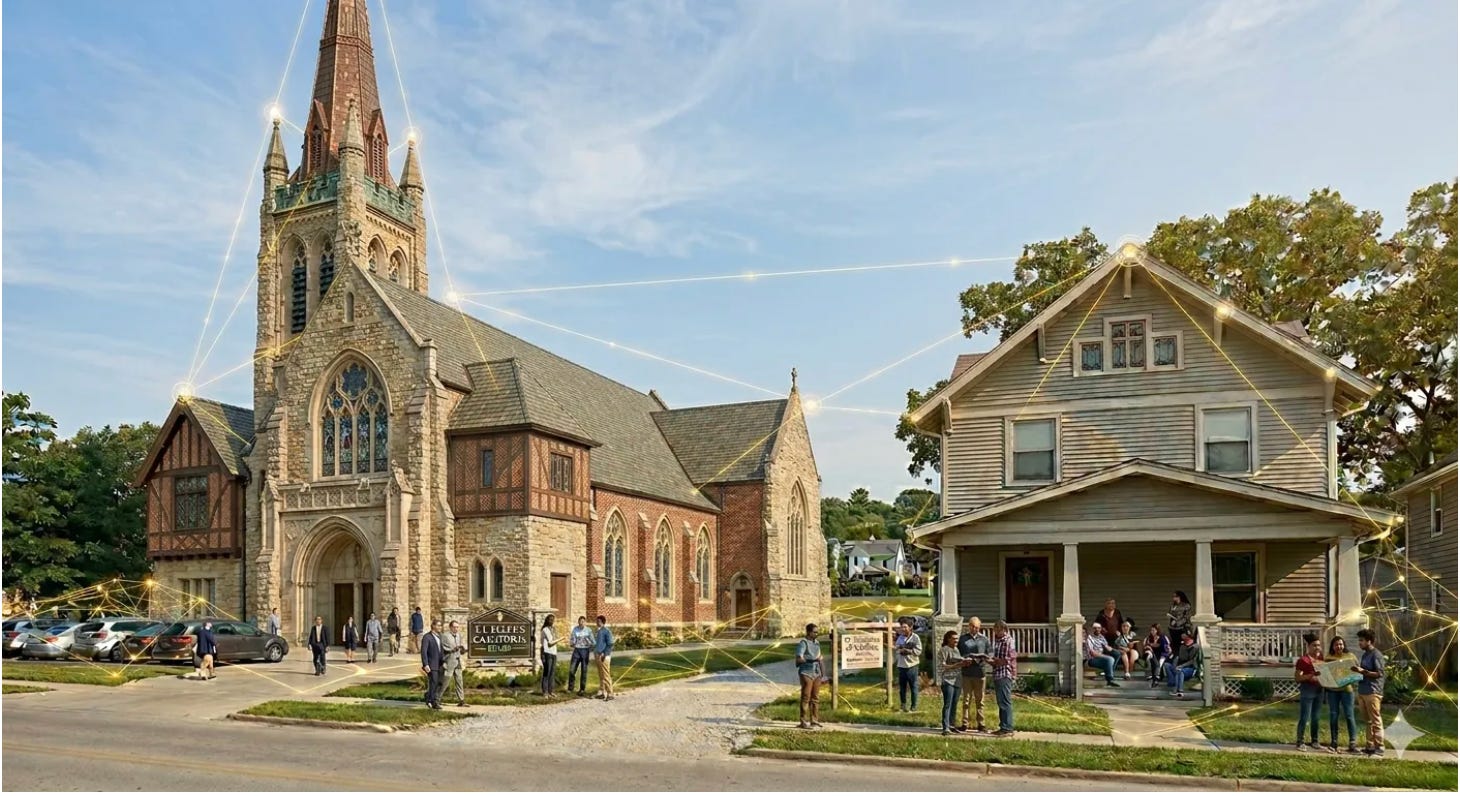
A 2,500-member congregation isn’t 2,500 relationships. It’s maybe 150 relationships surrounded by 2,350 strangers who happen to park in the same lot on Sunday. The size grows. The oikos doesn’t.
Compare that to Jesus’ own math. He had access to crowds of thousands (Matthew 14:21). He could have built the first megachurch in human history with a single afternoon of miracles.
Instead:
👉 He had dozens, and maybe hundreds, of followers.
👉 He chose twelve.
👉 He poured into three (Peter, James, John) more than the twelve.
Jesus wasn’t limited by a lack of resources. He was following a relational law of the universe: depth requires proximity, and proximity has a ceiling.
Every megachurch pastor knows this instinctively, which is why they build small groups inside the big group. But that’s the thing. If the real spiritual growth happens in the small group anyway, why do we keep building (and funding, and staffing, and insuring) the big container around it?
The One-Anothers Can’t Happen in a Crowd
Here’s a phrase we use constantly in the Disciple-Making Collective: the 59 “one-anothers.”
Fifty-nine times the New Testament tells believers to do something to and for one another, love one another, bear one another’s burdens, confess sins to one another, encourage one another, stir up one another to love and good works, forgive one another, serve one another.
Try to obey those commands with 2,500 people.
You can’t.
You physically, relationally, and logistically cannot. So what happens instead? The one-anothers get delegated.
Confessing sin becomes a pastoral counseling appointment.
Bearing burdens becomes a benevolence fund.
Encouragement becomes a greeting-time handshake.
The commands don’t disappear. They just get professionalized, and something is lost every time obedience gets outsourced to a staff member.
✔ In a simple church of 12-25, the one-anothers aren’t a program.
🔥 They’re Tuesday night simple church.
Multiplication Is Easy When the Unit Is Small
This should genuinely excite you.
Small isn’t just more relational.
It’s more reproducible.
Think about it like cell biology. A single cell doesn’t grow to the size of a building and then explode into a thousand new organisms. It reaches a healthy, sustainable size, and then it divides. Growth by multiplication, not by mass.
The church in Acts operated the same way. Nobody in Antioch was trying to build the biggest gathering in Syria. Paul and Barnabas planted, appointed elders “in each church” (Acts 14:23), and moved to the next city.
The Discipling-Making Collective pathway follows that same biological logic:
♻️ Seeker Group → X-Group → Discipling Community → Simple Church → Seeker Group → Etc.
Click Here for the Disciple-Making Pathway
Each stage is small enough that everyone in it can be known, and small enough that everyone in it can lead. And then it replicates.
That second part matters more than people realize:
✔️ A megachurch trains leaders for years before handing them responsibility, because the stakes of a platform mistake are enormous.
✔️ A simple church can hand a Three-Thirds meeting to someone who trusted Christ six months ago, because leadership here isn’t about performing for a crowd; it’s about faithfully facilitating a conversation among people who already know and trust you.
Low relational stakes = low leadership barrier = fast multiplication.
That’s not a compromise on quality.
That’s the apostolic design.
Your Oikos Is Already Sized for Multiplication
Let’s stop being theoretical and start being personal.
You already have a relational network sized exactly for this kind of multiplication. It’s called your oikos, the Greek word for the people connected to where you Live, Learn, Work, and Play. Most people, when they actually sit down and list it out (try the List of 100), discover they have 80-150 people they have real relational access to.
That’s not a coincidence. That’s Acts 17:26-27, God has “determined allotted periods and the boundaries of their dwelling place” so that people “should seek God, and perhaps feel their way toward him and find him.” He didn’t just place nations strategically. He placed you strategically, in the middle of a web of relationships sized perfectly for one person to steward well.
A prayer map (or oikos map) takes that invisible network and makes it visible: your name in the center, 5-10 names branching out, and then, if you’re praying and paying attention, their names branching out from them. Green for the ones making disciples. Yellow for the believers not yet living like missionaries. Red for the ones still far from Jesus.
That map is your simple church before it exists. It’s the relational soil the whole multiplication pathway grows out of.
The Persecution Test
One more relational advantage simple churches have that megachurches structurally cannot: antifragility.
When persecution hit the church in Jerusalem in Acts 8, the believers scattered. A megachurch model would call that a catastrophe: the building’s gone, the staff is displaced, the “ministry” is over.
But look at what actually happened: “Those who had been scattered preached the word wherever they went” (Acts 8:4). Scattering didn’t kill the movement. It multiplied it because the “church” was never the building or the brand; it was the relationships and the disciples carrying the mission in their own bodies.
A network of 100 simple churches can absorb a hit that would flatten a single 2,500-member institution. Not because simple churches are more resilient people, but because the mission was never centralized in one fragile container to begin with.

Helpful? Click the Button and Buy Me a Coffee.
So What Do You Actually Do Monday Morning?
Not “go plant a church.” Start smaller than that.
Pull out a piece of paper and build your prayer map. Name 5-10 people in your oikos.
Color-code them honestly—green, yellow, red.
Pick one red or yellow name and pray the BLESS prayer over them this week (Body, Labor, Emotions, Social, Spiritual).
Have one spiritual conversation before Friday.
That’s it. That’s the whole “strategy.” Because the multiplication math from Part 1, 100 churches planting one new church every two years, reaching 80,000 people in a decade, doesn’t start with a building fund or a five-year plan.
It starts with twelve people.
It starts with one name on a piece of paper.
It starts with you.
If you want to learn more about Simple Church, prayer mapping, and the tools that make relational multiplication actually work, DM me or go to disciplemakingcollective.com!
Pumped to get more time with you brother!
Kevin, this is such a good article and speaks directly to my heart. So encouraging! Thank you.