

Adapted from the stories of Paul and his letters to Timothy.
Twenty years.
That’s how long it has been since Paul was dragged from the Mamertine prison and led beyond the walls of Rome to die. Twenty years since the sword flashed in the sunrise light and the voice that once thundered through synagogues, marketplaces, prison cells, and storm-tossed ships finally went silent. At least in the form of spoken words and proclamations.
Voices like Paul’s do not stop speaking when they die. These voices become words in the mouths of those they leave behind. And men can’t help but proclaim them boldly despite his absence.
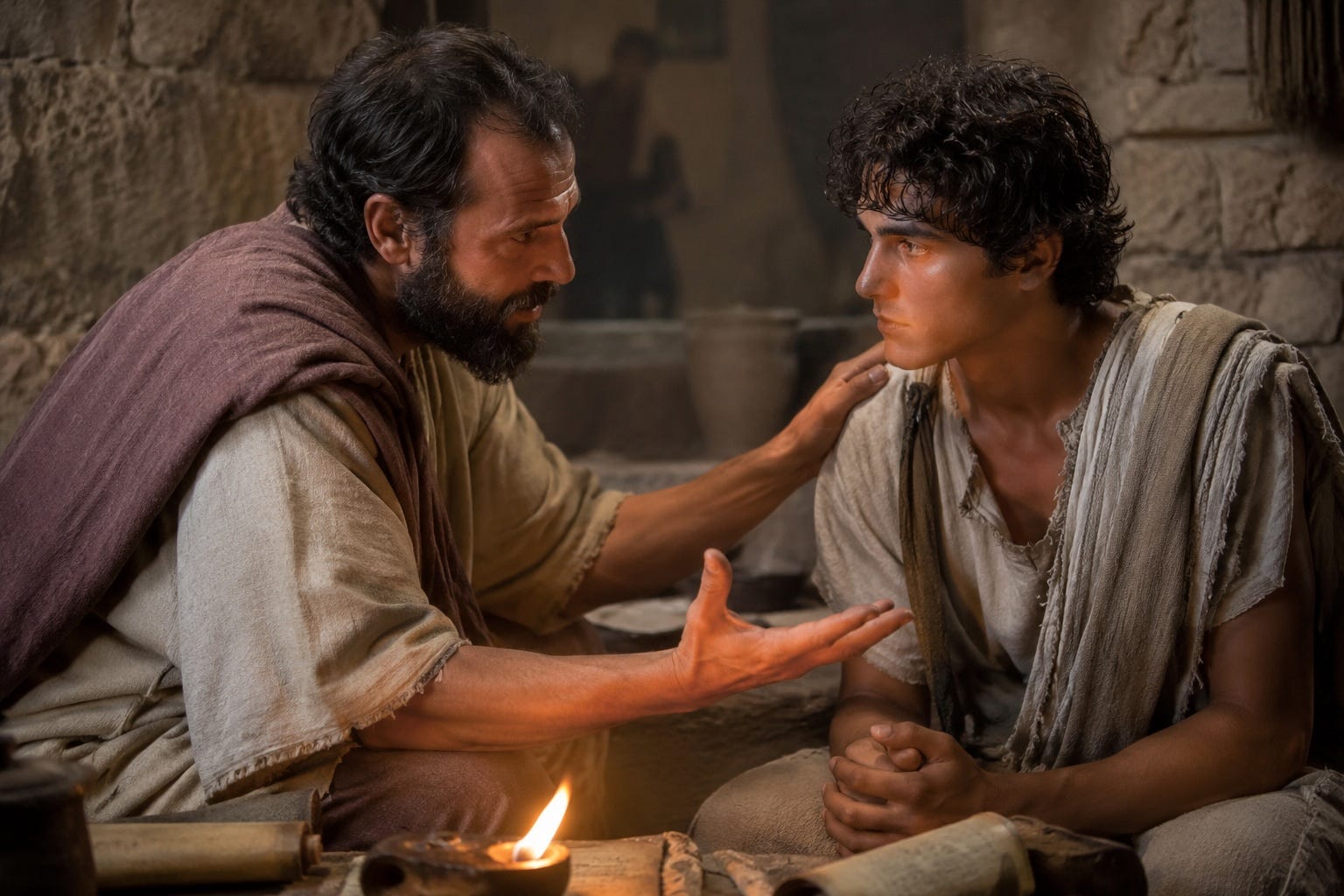
I am an old man now. My beard has gone white, and my hands quiver when I write. Ephesus has changed. Rome has changed. The churches he left behind have changed. Some of the young eyes never landed on the face of Paul, but knew him only through fragments of parchment read aloud in gatherings. To them, he is adjacent to myth now. The apostle. The church planter. The man who stood facing governors and kings.
But I knew the man when his feet were in chains. I knew the sound of his groans after floggings. I knew the look in his eyes when mobs turned against him. I knew what it was like to watch him pray through tears for churches that would later wound him deeply.
And I remember the exhilaration I felt when he called me “my true son in the faith.”1
Sometimes I still wake before dawn and imagine his voice quoting the Scriptures from memory while chains rattled against cold stone walls.
“Timothy,” he would say, “My true son in the faith. Persevere even in trouble. You will see God.”2
I have always believed him. But I have not always understood him. Not fully. You understand a man differently after you survive long enough to shoulder the weight he carried. After you face some of the same struggles he endured
I was young when we first met in Lystra. Half-Jewish, and he pursued me still. Timid, quiet, and afraid of disappointing those around me. Paul saw something in me I could not yet see in myself. That frustrated me sometimes. He kept calling strength out of me while I was still playing around with fear. Sometimes I just wanted to take my time. I always felt safer when I had space to process. I was slower than him.
I remember that day he asked me to join him. No grand speech or manipulation. Just VISION. Purpose that was grander than where I was. His body already carried scars from stones and rods and prisons. Most men would have slowed down after suffering like that, but Paul burned hotter. And that fire in his belly felt irresistible to a young, purposeless wanderer like me. Although I was quiet on the outside, there was a fire burning on the inside that couldn’t be quenched.
“Follow me,” he said.
When Paul said those words, you felt as if Jesus Himself were calling.3 I followed him into riots and miracles. Into hunger and holy moments I cannot explain. I watched demons scream and leave bound-up people. I saw hardened jailers collapse in repentance and put their lives on the line for the good news he carried. Entire households would enter baptism waters and weep with joy. And Paul could absorb pain like an anvil under the pressure of hammer blows.4
What kind of man keeps singing after being beaten nearly to death?5 What kind of man keeps loving those who constantly misunderstand him?6 Who walks back into cities where mobs tried to kill him just hours earlier?7 Only a man utterly possessed by the vision of Jesus and the passion of this great commission. It wasn’t intelligence, charisma, or grit that drove him. It was His uncompromising love of Jesus Christ, the Holy One. Paul never missed a moment of passionate service after meeting Him on the Damascus road.
Most of us slowly adapt Jesus into our lives. For Paul, it was in a flash of time that he abandoned it all. He never turned back from the moment he encountered our Messiah on the dusty, dirty road. And honestly, that terrified me sometimes. Because walking with Paul meant there was no safe version of Christianity left available to you. No half-hearted obedience. No compartmentalized faith. No serving Jesus on the Sabbath and building your own kingdom the rest of the week. Paul forced you to confront the possibility that Jesus actually deserved EVERYTHING.8
I remember one night after everyone else had fallen asleep. We were exhausted, hungry, and hiding. Again. I asked him quietly, “Do you ever wish for a normal life?” He softly laughed. Not mocking. Just tired. “Timothy,” he said, staring into the small fire between us, “I had more than you can imagine, and I was miserable. My life was garbage.”9
That sentence has haunted me for decades. I think many believers secretly want enough of Jesus to feel safe but not enough to ruin their plans. Paul had no such interest. Jesus ruined ALL his plans. And Paul considered it a gift from his Creator. He viewed the abandonment of his life as an honor. He expected nothing in return and held nothing back.
NOTHING.
I have buried friends now. So many friends. Some were killed. Some abandoned the faith. Some simply drifted into contentment and disappeared slowly into ordinary life until the fire in their belly went cold. Demas still hurts to think about. Paul saw it coming before I did. I’ll never forget the shocking plea in his letter to me. “Timothy, come quickly, for Demas, because he loved this world, has deserted me and has gone to Thessalonica.”10 The pain of that line stays with me even these twenty years later. He could always discern when love for the world was creeping into someone’s heart.
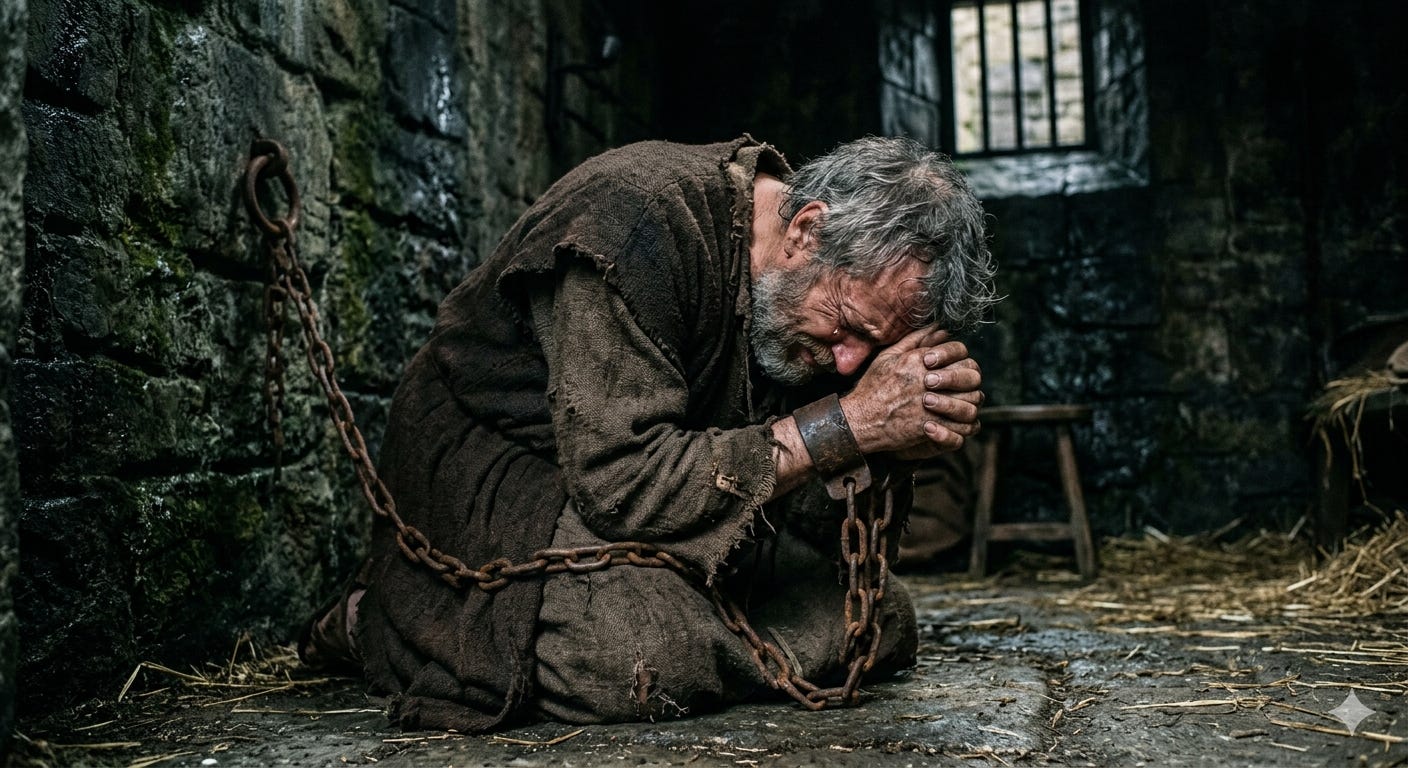
Near the end, Rome felt darker than ever. Nero’s madness poisoned the empire. Christians were hunted. Fear grew through the churches. People became cautious about their association with Paul once prison became a reality. I hate admitting this now, but even I wrestled with fear. Not fear of death exactly, but fear of suffering the way I had seen my friends, and even my family, writhing in pain. Martyrdom sounds noble when discussed in safe rooms around warm fires. But suffering makes the clock tick slowly, grinding out long nights. It wears down the soul. It attacks the resolve of the most loyal followers of the Way.
Paul understood this better than anyone.11 That is why his final letter to me was not so much a manual of strategy and instruction as it was of endurance in the face of challenge.
“Do not be ashamed.”12
“Share in suffering.”13
“God hasn’t given us a spirit of fear.”14
“The Word of God is not chained.”15
I can still feel the texture of the parchment. I can still see my tears falling onto it. It was as if I sat beside him and shared the pain of loneliness with him.
“Only Luke is with me.”16
The great apostle. The church planter. The miracle worker. Sitting in a cold Roman prison with only one friend beside him.
We secretly think faithfulness should eventually produce comfort. Paul’s life taught us the truth that shattered that lie into a million shards. Faithfulness produces resemblance to Jesus, nothing more, nothing less, and that is enough. That is the truth our hearts long to hear.
Twenty years later, I understand Paul far better than I did when he walked with us and admonished us with pen in hand. At times, I resented how hard he pushed me. How directly he confronted weakness. How unwilling he was to settle for shallow discipleship.17 Now I thank God for it.
The churches today face different pressures, but the temptations remain the same.
Fear.
Comfort.
Compromise.
Endless distractions.
Many want the benefits of the Kingdom without the surrender required to carry it. Paul would grieve that. But he would not despair. He never despaired of the gospel. Not once. Even chained in prison awaiting death, he still believed the Word of God was more valuable than the wealth of this world. And that lives of faithfulness would lead to ultimate fulfillment.
And somehow, for me, it has.
Nero is dead. Rome is fading. But the gospel keeps moving from household to household, city to city, nation to nation. Just as Paul said it would.
Sometimes those younger ask me what Paul was really like. I usually pause before answering. Because how do you explain a raging wildfire to someone who has only seen flickering candles? How do you explain a man who loved Jesus so completely that incredible suffering became secondary to faithfulness?18
I often think about his final moments. Did he quote Scripture as they led him away? Did he pray for Nero? Did he bow his knee to Jesus before the sword fell?
I do not know.
But I know this: Paul was never the hero of the story. He would never want us to make him one. No, Paul was a WITNESS. A blazing, relentless witness to the reality that JESUS CHRIST IS ALIVE.
And now my own life is nearly spent. I feel it. The race is drawing nigh before me. Soon I will be with Paul again. And together, we will be with the Rabbi. The One who was worth shipwrecks and scars. Worth prison and rejection. Worth loneliness and death. Worth throwing our entire lives away in order to accept the mission to make Him known above all rulers and royalty.
Paul taught me many things over those years on the road. But perhaps the greatest was this: The Kingdom of God is not carried forward by impressive men.19 It is carried forward by wholly surrendered followers of Jesus.
Twenty years ago, I walked with him. I saw his abandonment. I benefited from his example. Although the context is different, the words of Christ stand. “Blessed are those who have not seen and yet have believed.”20 The further we move away from the story, the more likely we are to lay down the cross and embrace another pursuit. One that is easier and seems to bring more promise. But stop and reflect on the life Paul lived for us to see. I dare you to dream of what it must feel like to die for the sake of a mission that has eternal consequences for a multitude of people living without the knowledge of our God.
Twenty years later and beyond, how do we respond to a radically submitted life like that? We do what he instructed us to do, and we do it with full abandon. He said it in that last letter I received.
“Now teach these truths to other trustworthy people who will be able to pass them on to others.” 21
Think about it. Count the cost. I beg of you, consider the payoff and the consequences of radically turning toward the mission and linking arms with Jesus.
What might that mean for your tomorrow❓

Footnotes:
Although these are not always directly quoted in the story, we can assume that Paul would have spoken these things to Timothy, as he had many other disciples throughout his ministry.
1 Timothy 1:2 - ”May God the Father and Christ Jesus our Lord give you grace, mercy, and peace.” (NASB)
1 Timothy 4:16 - "Watch your life and doctrine closely. Persevere in them, because if you do, you will save both yourself and your hearers.” (NASB)
1 Corinthians 11:1 - "Follow my example, as I follow the example of Christ." (NIV)
2 Corinthians 11:23-28 - “Are they servants of Christ? (I am out of my mind to talk like this.) I am more. I have worked much harder, been in prison more frequently, been flogged more severely, and been exposed to death again and again. 24 Five times I received from the Jews the forty lashes minus one. 25 Three times I was beaten with rods, once I was pelted with stones, three times I was shipwrecked, I spent a night and a day in the open sea, 26 I have been constantly on the move. I have been in danger from rivers, in danger from bandits, in danger from my fellow Jews, in danger from Gentiles; in danger in the city, in danger in the country, in danger at sea; and in danger from false believers. 27 I have labored and toiled and have often gone without sleep; I have known hunger and thirst and have often gone without food; I have been cold and naked. 28 Besides everything else, I face daily the pressure of my concern for all the churches.” (NIV)
Acts 16:25 - “About midnight Paul and Silas were praying and singing hymns to God, and the other prisoners were listening to them.” (NIV)
2 Peter 3:16 - “Some of his comments are hard to understand, and those who are ignorant and unstable have twisted his letters to mean something quite different” (NLT)
Acts 14:19-20 - “But Jews came from Antioch and Iconium, and having won over the crowds, they stoned Paul and dragged him out of the city, supposing him to be dead. But while the disciples stood around him, he got up and entered the city” (NASB)
Colossians 1:16-18 - “For by Him all things were created, both in the heavens and on earth, visible and invisible, whether thrones or dominions or rulers or authorities—all things have been created through Him and for Him. He is before all things, and in Him all things hold together. He is also head of the body, the church; and He is the beginning, the firstborn from the dead, so that He Himself will come to have first place in everything.” (NASB )
Philippians 3:8 - “More than that, I count all things to be loss in view of the surpassing value of knowing Christ Jesus my Lord, for whom I have suffered the loss of all things, and count them mere rubbish, so that I may gain Christ” (NASB)
2 Timothy 4:10 - “for Demas, because he loved this world, has deserted me and has gone to Thessalonica. Crescens has gone to Galatia, and Titus to Dalmatia.” (NIV)
Romans 8:18 - “I consider that our present sufferings are not worth comparing with the glory that will be revealed in us.” (NIV)
1 Timothy 1:8 - "So do not be ashamed of the testimony about our Lord or of me his prisoner.” (NIV)
2 Timothy 1:8 - "share in suffering for the gospel by the power of God." (ESV)
2 Timothy 1:7 - “For God has not given us a spirit of timidity, but of power and love and discipline.” (NASB)
2 Timothy 2:9 - “I suffer hardship even to imprisonment as a criminal; but the word of God is not imprisoned.” (NASB)
2 Timothy 4:11 - “Only Luke is with me.” (NASB)
Colossians 1:28-29 - “We proclaim Him, admonishing every man and teaching every man with all wisdom, so that we may present every man complete in Christ. For this purpose also I labor, striving according to His power, which mightily works within me.” (NASB)
2 Corinthians 11:30 - “If I must boast, I will boast of the things that show my weakness.” (NIV)
1 Corinthians 1:27 - “but God has chosen the foolish things of the world to shame the wise, and God has chosen the weak things of the world to shame the things which are strong” (NASB )
Jesus in John 20:29 - "Because you have seen Me, you have believed. Blessed are those who have not seen and yet have believed." (ESV)
2 Timothy 2:2 - “And the things you have heard me say in the presence of many witnesses entrust to reliable people who will also be qualified to teach others.” (NIV)
“Faithfulness produces resemblance to Jesus” hit me. Paul’s life confronts our cleaned up version of Christianity where we want enough Jesus to comfort us but not enough to claim our whole life!
Kevin, thanks for this creative writing on " Paul: A Life That Never Stops Speaking. " It spoke to my heart.