

Adapted from the Story of Rahab in Joshua 2:1-24 and 6:1-27.
“Before the spies lay down for the night, she came up to them on the roof and said to them, ‘I know that the Lord has given you this land and that a great fear of you has fallen on us... for the Lord your God is God in heaven above and on the earth below.’” - Joshua 2:8-9, 11
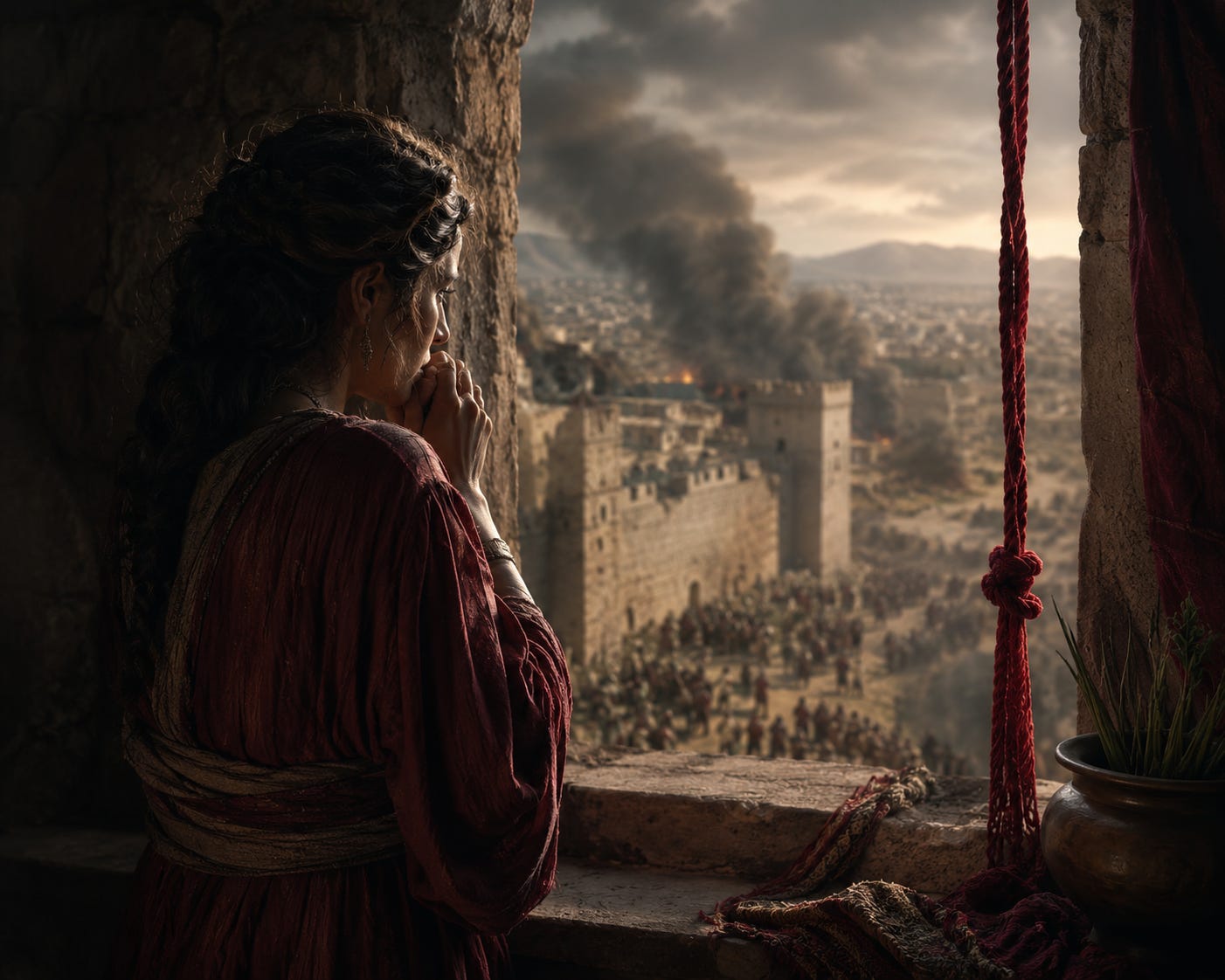
I am Rahab.
My name means the proud one, and it was almost enough to mask what was happening on the inside. Below the surface, I was anything but proud.
You’ve known people like me. I was the talk of the town. Every woman in Jericho knew my name. Not because of anything worth being known for. But for the kinds of things that turn every eye when you walk by. The kinds of things that only happen with women like me when more acceptable women have settled in for a quiet night’s sleep.
I had learned early that the world would give you what you needed as long as you sold yourself for what they wanted. That kind of survival required you to decide what you were willing to give and what you would protect at any cost. I had already decided. I had drawn my lines. And I had built a life inside the walls of the most fortified city in Canaan, in a house embedded in those very walls. Somehow, I thought they might just be thick enough to protect my heart.
After the spies left my house, a red rope hung from my window. But before they left, it wasn’t a rope, but a reputation that hung over my head. It made religious men cross the street and kept safe ones at a distance. Despite my name, I was not proud of it. I want you to understand that clearly.
No, I was not proud.
I was surviving.
There is a difference, though most people who have never had to survive don’t bother to try to understand it.
The Stories of the Coming Army
You have to know what it was like inside those city walls. The stories moved through the market stalls and down the alleyways of Jericho like wind before a storm. And before the spies arrived, those stories focused on Israel's strength. A wandering nation that should have been about as threatening as an ant in a trap.
The Red Sea? Parted.
Two kings east of the Jordan, Sihon and Og? Destroyed utterly.
The God of their strength? Unstoppable!
Those realities couldn’t be explained by human strength.
An entire nation of slaves, wandering the wilderness for a generation, being forged into something none of us had a category for. An army that didn’t fight as other armies fought. A people who carried their God with them in a box and followed a pillar of fire through the night.
Our king reinforced the gates. He doubled the guards on the wall. He held councils and drew up strategies and spoke publicly about the invincibility of Jericho’s defenses. But it was obvious to us.
He was terrified. We all were.
But in my heart, somewhere underneath the fear, something else had taken root. Because the God of these people, this God who split seas and swallowed armies, He was not like the gods of Jericho. Our gods demanded. They consumed. They were hungry and unpredictable and as indifferent to human suffering as the sun is indifferent to what it scorches. We were required to serve them.
But this God was different.
I couldn’t have explained it then with the words I have now. But even before the two strangers climbed the stairs to my roof, something in me had already begun to point to belonging to a story I had no right to be part of.
I knew who they were the moment I saw them. Not because they necessarily looked like Israelites; all varieties of travelers came through Jericho. But there was something about the way they moved. The way they watched. And the particular nervousness of men who know that the city they’ve walked into is looking for them.
My life had trained me to read people quickly. It was a survival skill. I had a choice in that moment that I’ve rehearsed in my head a thousand times since. I could have sent word to the king’s men. I would have been rewarded. I would have been safe, another year, another negotiated season away from a life of living in fear and rejection.
Instead, I heard a small voice say, “There’s a better way.”
I hid them beneath the stalks of flax drying on the roof. And when the king’s messengers came to my door, I looked them in the eye and lied. Let’s rest there for a moment. As broken as I was, I am not a liar. But I lied. I chose these strangers over the king, who owned every stone of the city I lived in. I chose a God I had only heard rumors about over what I could see with my own eyes.
I’ve asked myself many times since, “What compelled me?”
I had already seen enough of how the gods of Jericho treated women like me. And the stories I had heard about this other God, the way He moved through history, the way He remembered His people, the way He made a way where there was absolutely no way, something in the most calloused corner of my heart whispered that a God like that might be worth the risk.
Desperate people make desperate choices.
And perhaps the most desperate thing of all is deciding to believe in something you cannot yet see. Risking it all that He is real. And that He cares about me. And that He would also make a way for me, a lost woman in a brutal culture, serving cruel and punishing gods.
When I went back to the roof, I didn’t pretend.
I told them what I knew. I told them that the fear of their God had fallen on all of us like a heavy stone. And then, with my heart pounding in my chest like a fist banging on a door, I asked for the only thing that mattered to me.
I asked for the protection of my family.
Not wealth. Not status. Not even my own life, I had long since stopped valuing that the way I should have. My mother. My father. My brothers and sisters. The people who had never quite known what to do with me but who were all that I had. The only people in my known world that I still trusted.
“Swear to me by your God,” I said. “Swear that you will show kindness to my family as I have shown kindness to you.”
There is something extraordinary about that word. Kindness. In their language, it is the word that means covenant love. Loyal love. The kind that doesn’t evaporate when circumstances change. I was asking strangers, in the name of a God I didn’t yet fully trust, for a promise that I couldn’t believe until it could have been too late to matter.
They swore it.
And I let them down from the window by a rope.
A scarlet cord.

The same color as blood. As a sacrifice. As the mark on a doorpost (they have told me since) that tells the destroyer to pass over. I didn’t know all of that then, not with the fullness of understanding I carry now. But I tied that cord in the window, and I looked at it every day, with intense anticipation, as the sound of a marching nation grew louder on the other side of those walls.
Six days of grinding it out. Thinking that it was all a myth. But the shaking began on the seventh day of their march around the city.
I had gathered my family in that room. My mother was weeping. My brothers were pacing. We pressed ourselves into the center of the floor as the walls of Jericho, walls wide enough to build houses in, walls that had stood longer than anyone in the city could remember, began to crack and groan and give way in a roar that I felt in my chest more than I heard with my ears. My blood was pumping, and questions were screaming at me.
Would they be trustworthy?
Would they follow through with their promise?
Were they even still alive?
And then.
Every wall fell.
Every wall.
Except the ones that, for years, had hidden my shame and fear.
I don’t have adequate words for the moment I realized that. I don’t have words for what it does to a person when the thing they staked everything on, a promise, a scarlet cord, a God they’d only heard rumors about, is fulfilled. And in a way that human reasoning cannot explain.
When the dust settled, two familiar faces appeared at my doorway. They took us out, my mother, my father, my brothers, my sisters, all of them. I wept in a way I hadn’t let myself weep in years.
I wasn’t a weeping of grief.
It was something rawer, and stranger, and better than grief.
The feeling of being known and remembered.
Of having been seen, across the distance of my worst decisions and my longest nights, by a God who apparently had been keeping track of a woman in a window with a scarlet cord and a desperate prayer.
They brought us outside the camp of Israel first. As a Gentile, ceremonially unclean. Not yet fully in. I understood that. I didn’t rush it. I sat in that in-between space and let it settle over me that I was alive, when many of my friends and acquaintances weren’t.
My family was alive.
And the God who split seas had somehow thought it important to look after a woman from Jericho who had no business being in this story at all.
I’m told that is how He works.
Finding the ones that the rest of the world has already written off and writing them into something they couldn’t have imagined for themselves.
I have a new family now. A new home.
A name that is being slowly redeemed from everything it used to mean. They tell me that my name will go down in their record books as one who helped them take Jericho. That their… wait… that OUR people will remember my name forever.
Me? A prostitute in a foreign land and belonging to a foreign people?
How could it be?
I still think about that scarlet cord in the window. The desperate, reckless, barely-believing act of hanging it there and trusting that someone on the other side of the wall would see it and keep their promise.
And I want to ask you, today…
What wall have you been hiding behind, convincing yourself you’re too far outside the camp to ever truly belong, and what would it cost you to hang the cord anyway and find out if He sees it?
What if you just took a chance and risked seeing if He would be faithful to you, too?
Why not?
What have you got to lose?
I am Rahab. I was a prostitute and a Gentile.
And my name will go down in His story for the ages to know that I chose to trust Him when there was no way.
Jen Wilkin does a great study on the book of Joshua shedding very similar light on Rahab and the beauty of her redemption… she even points out in that culture it was highly likely her family sold her into her prostitution for survival…that she had no choice…
But thank you and thank you for your reflection questions…I needed to read this… 💓🙏🏽🥲
There you go again – lauding scandalous grace. Whether a thief on a cross or a prostitute within thick walls, their salvation was unmerited. And so is ours.
Keep up the good work, Kevin!