

Story adapted from the thief on the cross in Luke 23:39-43.
He could have used his final few words to save Himself. He knew the time had come. He should have cried out for an angel army. But He wasted them on me!
I didn’t have the clarity of mind to even consider rejecting such a selfish desire as the iron spike tore through my wrist. I screamed until my throat burned like fire. And honestly, I don’t even know how I pulled it together to utter my final request before my deadly punishment.
In my mind’s eye, I’m staring at it now. That thick, rusted nail pinning my flesh to the wood. Blood running down my arm in rivers, dripping from my elbow to the ground below. I had tried to shift my weight, tried to find some position that didn’t send lightning bolts of agony through every nerve in my body. But there was no relief. Only the slow, agonizing rhythm of pulling myself up to breathe, then collapsing back down when my legs could no longer bear the weight.
Crucifixion. This is what it’s like!
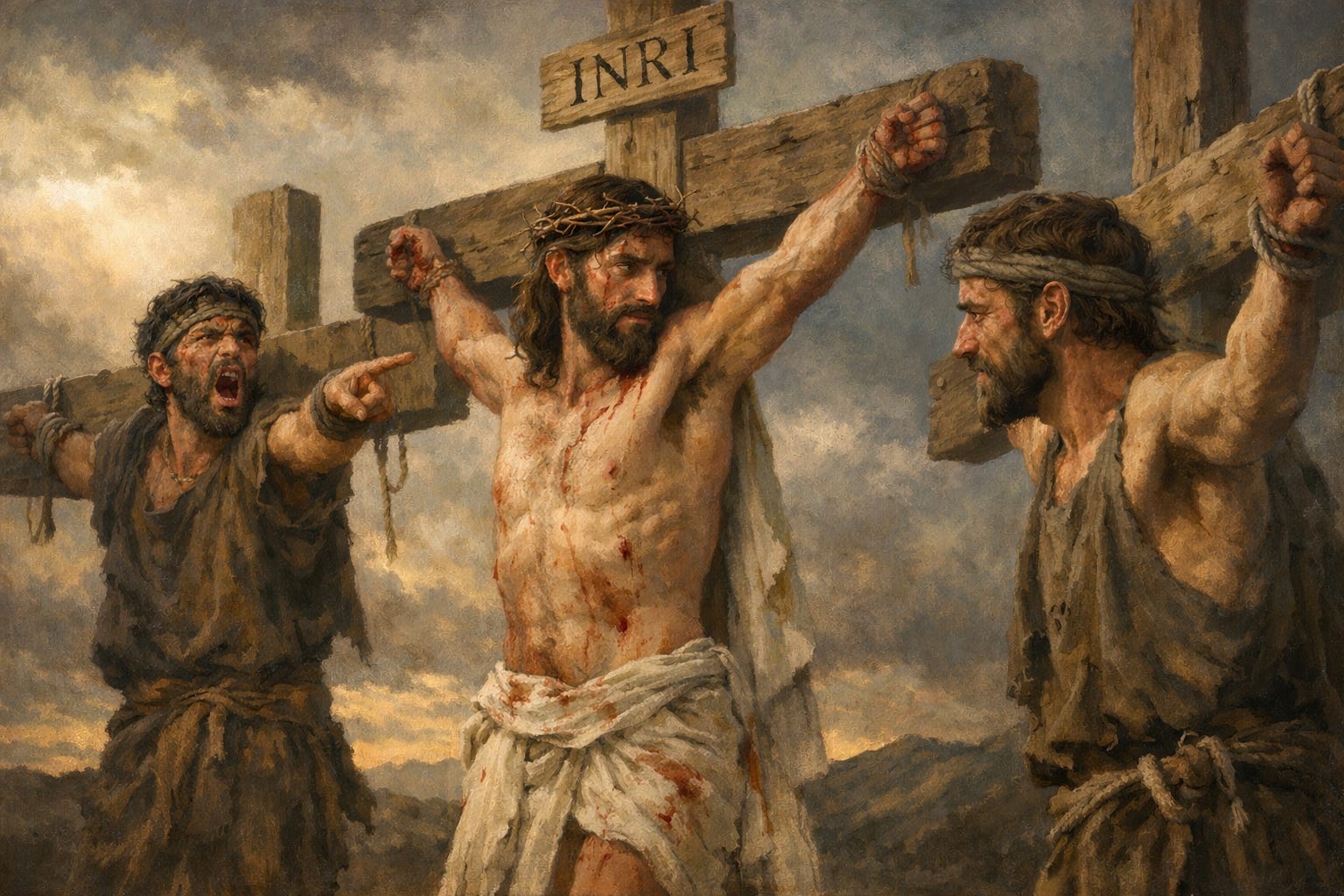
I’d heard about it. Seen it from a distance once or twice when the Romans made their bloody examples of other rebels and thieves. But I never imagined. I never could have imagined what it actually felt like to hang there.
Naked.
Exposed.
Dying one excruciating breath at a time.
My name doesn’t matter now. Nobody will remember it. Just another criminal. Just another thief who got what he deserved. That’s what they were thinking down there, the soldiers gambling for my clothes, the priests who came to watch, the women weeping for the man in the middle.
The man in the middle.
Jesus of Nazareth. King of the Jews, the sign above His head read. They were mocking Him with that title. The religious leaders were spitting at Him, hurling insults toward his ears. “He saved others,” they shouted with judgment, baptizing every word. “Let Him save Himself if He is God’s Messiah!”
I had slowly turned my head toward Him just moments earlier. Through the blur of pain, I saw Him. Beaten beyond recognition. Blood covered His face from the thorns they’d twisted into a crown. Welts and gashes across His back from the whipping.
A black hole of my own agony was vying for my attention, but I couldn’t ignore Him. No matter how hard I tried.
There was something in His eyes. Something I couldn’t name.
Although I had never felt love before, never experienced another person’s heart being turned toward me, never felt the warmth of even my mother’s face shine upon me, I somehow knew love fully at that moment.
The man on my other side was Gestas, I think they called him. He’s been screaming at Jesus since they raised us up on that wood. “Aren’t You the Messiah? Save Yourself and us!” He spat the words between gasps for air.
Mocking.
Hardened.
Bitter.
Desperate.
I wanted to join him. I really did. Because isn’t that what we do when we need to justify ourselves? We blame everyone else to try to avoid facing the consequences of our own choices.
But, as much as I tried, I couldn’t.
I couldn’t because every time I looked at that man in the middle, I saw something that made my throat tighten with more than just the pain of suffocation. I saw innocence. I saw dignity. I saw peace. Strength I’d never witnessed in all my years of violence and theft.
Let me tell you how I got here.
I wasn’t born a thief. Nobody is. I was a boy once, running through the fields outside Jerusalem, helping my father tend sheep. Hoping for his embrace, but never receiving it. I never knew my mother. But what I do remember is still believing that goodness was attainable if I just tried hard enough.
But life has a way of beating hope out of you. My father died when I was twelve. He was crushed under a cart wheel that gave way on a mountain path. Roman taxes took our land. I was with my extended family in proximity, but far from the home I never had in the place of my heart. At 15, I sealed the deal and ran.
The streets taught me what I needed to survive. Steal or starve. Kill or be killed. Trust no one. Take what you can because nobody’s going to provide what you need. This was how life worked for a 15-year-old who lost it all before he had it to lose.
I was good at this lifestyle. It started with bread from the market. Moved up to coin purses. Eventually graduated to armed robbery on the trade routes. Gestas and I worked together. We did what we could to make it through another day.
The first time I killed a man, I vomited afterward. The second time, I cried. By the tenth, any reaction at all would have been more than I felt in my heart. I was cold. My heart was a hardened stone. All I thought about was dulling the pain of never knowing love.
I told myself they deserved it. The wealthy merchants with their loaded donkeys and their soft hands. The priests with their clean robes, their shallow prayers, and bellies full of yesterday’s sacrifices earned by more noble subjects. They’d taken everything from people like me. I was doing what any reasonable man would do. I was just taking it back.
But the truth? The truth I couldn’t escape as I lay in bed at night with my heart beating faster and adrenaline feeding my dark, empty soul.
I liked it.
I liked the power. I liked the fear in their eyes. I liked taking what wasn’t mine. I knew someday I would pay the price, but I didn’t care. It would be worth it.
But I never could have imagined this!
Not this kind of pain and agony.
They caught us three days ago.
We’d ambushed a small caravan outside Jericho. It should have been easy with four travelers and only two guards. But the guards were better trained than we expected. One of them was a retired centurion. He cut down two of our men before we even knew what hit us.
Gestas and I tried to run, but Roman patrols were already sweeping the area. We didn’t stand a chance. They beat us bloody, dragged us back to Jerusalem in chains, and sentenced us to crucifixion the next morning, anxious to see us bleed out before the start of their blessed festival.
I spent my last night in a cell, listening to the sounds of other prisoners weeping and cursing. My thoughts began to fade, and the wretched sounds grew faint as I thought about my mother.
My mother?
Why?
I never knew her. I’m sure my eyes took in her smiles when I was in my first days. But how could I remember my earliest days? How could I now feel her presence? The sadness was agony. The emptiness as dark as a covered tomb.
That memory of a moment I couldn’t have actually known triggered a torrent of emotions that flooded me like a dam breaking in a violent storm.
I thought about all the people I’d hurt. The faces I could still see when I closed my eyes. The merchant I’d beaten so badly he couldn’t walk. The old woman whose life savings I’d stolen to buy a night with a prostitute. The young man who begged for his life while I held a knife to his throat.
I’d spent so long telling myself I had no choice, that my story made me this way and there was no way out. But in that cell, with death waiting for me at dawn, I couldn’t hide from the truth anymore.
This was what I deserved.
And there we were.
Three crosses on a hill called Golgotha. The place of the skull. The hill of the dying. The home of the fate of so many wicked.
My body was shutting down. Every pull upward to breathe was harder than the last. My vision blurred and cleared in waves like a pendulum counting down my final moments.
Blood loss.
Exhaustion.
The slow shutdown of a body that couldn’t give any more. I’m dying. We were all three dying.
But somehow we were not dying the same death.
Gestas was still raging. Still cursing. Still demanding that Jesus prove Himself by coming down from the cross and taking us with Him. He couldn’t accept it, couldn’t accept that this was the end, that we brought this upon ourselves, and that we deserved our fate.
But I did accept it.
Maybe it’s because I was tired. Maybe it was because I had finally run out of excuses. Or maybe, just maybe, it was because something in me broke when I looked into the eyes of the man in the middle.
“Don’t you fear God?”
The words ripped out of my throat before I could stop them. I turned my head toward Gestas, ignoring the fresh wave of pain. “We’re getting what we deserve. But this man has done nothing wrong!”
Silence fell over this little corner of Golgotha. Even the soldiers paused their dice game to look up at me. The crowd quieted. I realized I had shouted more loudly than I had planned.
I turned toward Jesus. His eyes met mine, and I felt something crack open in my chest, something that had been locked away for so many years I’d forgotten it existed.
Hope.
Not hope that I’d escape this cross, that fate was sealed. Not hope that some miracle would spare me from death, I knew that story had already been written. But hope that maybe, just maybe, there was something more than this. Something beyond the pain and the shame and the wasted years. And just maybe there was still a way for me to walk into eternity with more than I deserved. Maybe it was in the loving gaze of the man in the middle.
“Jesus.” His name felt strange on my lips. Like more right than I could have thought possible. “Remember me when You come into Your kingdom.”
I didn’t understand it. I still don’t. I just knew that if this man really was a king, as the plague read, and if He really did have some kind of kingdom waiting on the other side of death, then maybe He had the power to remember me. Not for who I’d been. Not for what I’d done. But for who I wished I could have been.
One moment of clarity at the end of a selfish, seemingly wasted life.
He turned His head toward me. Through the blood and the pain, He smiled. He actually smiled.
“Truly I tell you.”
His voice was gentle, like He was sharing a secret just between us.
“Today you will be with Me in paradise.”
Paradise.
The word still echoes in my mind as tears fill my eyes.
Paradise.
I don’t deserve it. I haven’t earned it. I’ve lived a life of violence and theft and selfishness. I’ve hurt people. I’ve taken lives. I’ve spat in the face of every decent thing.
For a moment, I thought this was some disgusting joke, but as I glared into His eyes, I knew that couldn’t be. He meant it from the deepest places of His heart.
“Today you will be with Me in paradise.”
Not tomorrow. Not after I’ve made amends or done penance or somehow earned forgiveness. Today. Right now. In this very moment, when I have nothing left to offer except the broken pieces of a ruined life and a whispered prayer from a dying thief.
The darkness closed in. My lungs began to fail. Each breath was a battle I was losing. But, somehow, the fear was gone. Something I had never felt was transforming me from the inside out.
Grace.
The unearned, undeserved, unfathomable gift of radical, reckless, scandalous grace.
I wasn’t afraid any longer. Not of death. Not of what would come after. Because He promised. The King promised that a wretched thief would be with Him in paradise.
My eyes have closed now. The sounds of Golgotha have faded. The jeers, the weeping, the cries from children, the hammer of soldiers breaking legs to speed up death. It all feels long ago, like in a life I'd already lived or a nightmare from which I’d already awakened.
I died a free man.
Free from the chains of who I used to be. Free from the prison of my own making. All because I looked at a dying king and asked Him to remember me.
Here’s what I need you to understand.
It’s never too late. Even at the end. Even when you’ve wasted everything. Even when you have nothing left to offer but the ragged truth of who you are. I spent my whole life taking. In my final moments, I learned to receive.
So I ask you, what are you waiting for? What pride, what shame, what self-sufficiency is keeping you from turning your head toward Him and whispering, “Remember me”?
Because He will. Oh, He most certainly will.
Even if you’re dying on that rugged, splintered cross you built yourself.
He will remember.

I deeply appreciate the heart behind this piece truly. The emotional weight, the sensory detail, and the focus on grace in a final moment are beautifully expressed. It draws the reader into the scene in a powerful way. I would like to gently offer a historical and cultural lens that may add another layer to how we understand the man beside Yeshua on the cross.
In our modern readings, the two men crucified with Him are often described as common thieves, violent criminals, robbers, or morally hardened men like the one portrayed here. But historically, that is very unlikely.
The Greek word used in the Gospel accounts is lēstai (plural of lēstēs). While it can mean “robber,” in first-century Judea it was commonly used by Rome to describe insurrectionists, rebels, or zealot-type resistance fighters, commonly Jews who opposed Roman occupation. Ones fighting for Jewish freedom from the empire.
Crucifixion itself supports this. Rome did not typically crucify petty thieves. Crucifixion was a public, political execution reserved for:
Rebels
Insurrectionists
Runaway slaves
Enemies of the state
It was meant as a warning: “This is what happens if you oppose Rome.”
That context aligns closely with Jesus’s own charge in the placard above His head read, “King of the Jews.”
That was not a theological accusation. It was a political one. Rome is saying this man committed sedition by claiming to have more authority than Caesar.
So the men crucified beside Him were likely fellow Jewish rebels which makes the moment in Luke 23 even more profound because one of them recognizes something the crowds do not.
He does not ask to be rescued from Rome.
He does not ask to come down from the cross.
Instead, he addresses Jesus as King and says, “Remember me when You come into Your kingdom.” That is a royal appeal, not merely a plea for mercy, but an acknowledgment of kingship even in apparent defeat. In that light, the exchange becomes less about a violent thief receiving last-minute forgiveness and more about a condemned Jewish rebel recognizing his true King, the heir of David, who will come and take the throne in the future, in the final moments of his life. After likely fighting for freedom from Rome, he recognizes his King, the one he's been waiting for, the Messiah. It transforms the scene from only personal redemption to covenantal and kingdom recognition.
Both readings carry beauty so understanding the historical context of Roman crucifixion and the meaning of lēstai helps ground the moment more firmly in its first-century Jewish reality.
I’ll include below a link to an article I wrote exploring the cross and crucifixion context more fully for those who may want to study deeper.
https://fromthegardengate.substack.com/p/the-two-thieves-a-covenant-drama
Devotional imagination can move the heart while historical context roots the story in the soil where it actually happened. When we hold both together, the scene often becomes even more powerful.
Again, very well-written, and very moving.
Great article! Thank you for the post.