

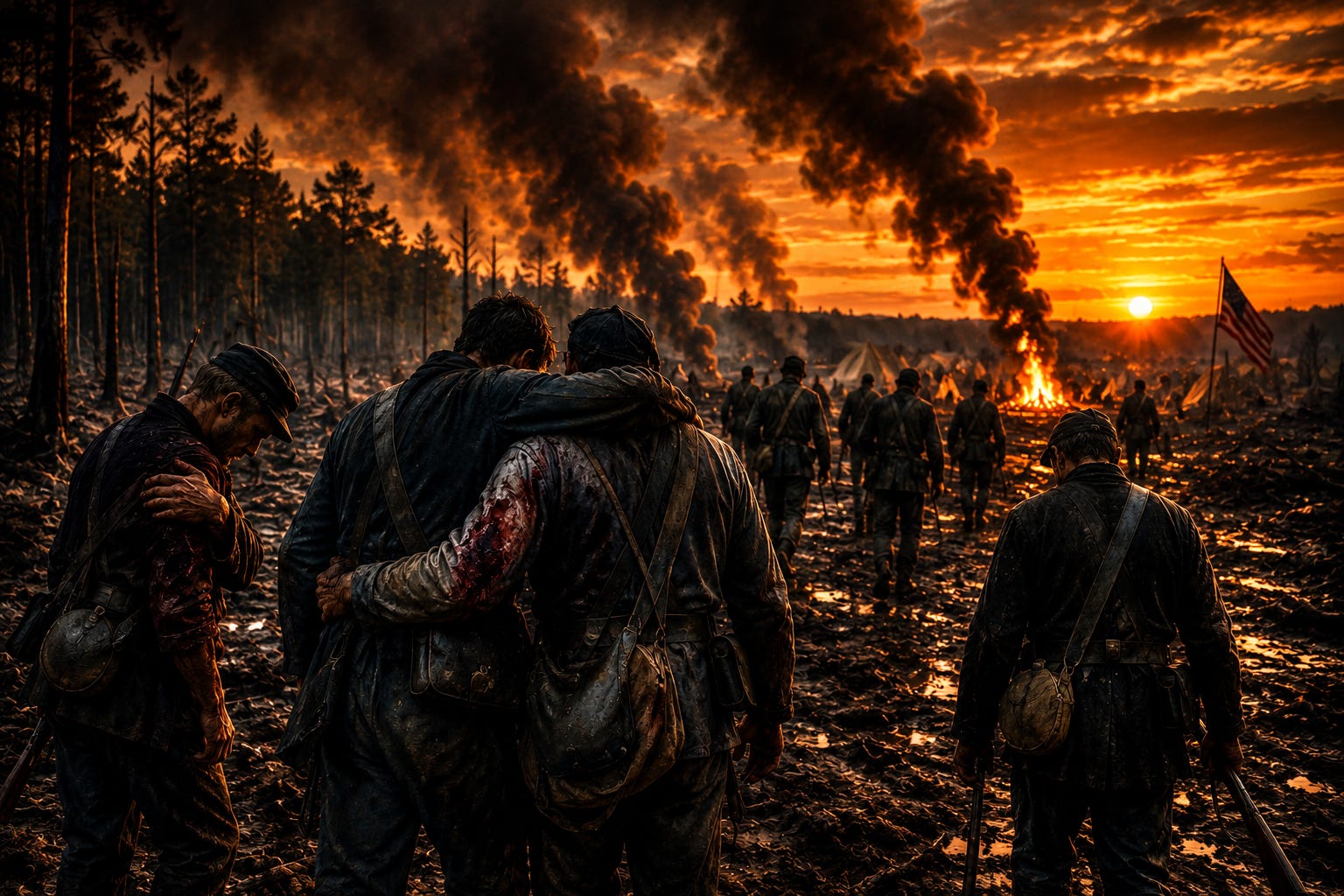
Imagine This! Standing in an open field with your eyes on the horizon. The sun is going down over the battlefield. The smoke hasn’t cleared. The smell of gunpowder wafts through the air.
And stumbling out of the tree line, a company of soldiers is making their way back toward camp. Some are holding their shoulders. Some are limping. One man has his arm draped around his buddy just to keep upright. The others are moving on nothing but willpower and a desire to find some measure of relief.
🚫 They’re not looking for a meeting.
🤕 They are hungry and bleeding.
🔥 They’re looking for a fire.
❤️🩹 They are looking for support.
🚶♀️🚶🚶🏽♂️They need each other.
Somewhere in the distance, a large bonfire burns on the horizon, visible through the smoke and the confusion. Leading them to rest. And battle-weary soldiers who have lost their bearings know exactly what it means: that’s where safety is. That’s where food is. That’s where the people who know what I’ve been through are waiting.
They walk slowly but urgently toward it ready for support and healing.
That image is one of the most clarifying pictures of what the gathered church is actually supposed to be.
Not a performance, or a program to be managed, or a service to be attended.
🔥 A fire. A beacon. A place where the weary come home so they can go back to the front line tomorrow armed, healed, rested, and ready for the MISSION.

Dig Deeper In My Latest Book - Click HERE.
You’ve Been to Battle. Did Anyone Ask?
If you’ve been doing the real work of disciple-making, walking into your oikos, having spiritual conversations with your neighbors, praying over your workplace, and showing up as a sent one (missionary), you know what the soldiers coming out of that tree line feel like.
· It’s exhilarating.
· AND it’s exhausting.
Some days, the Spirit moves in a conversation that rips a discipling relationship wide open. Other days you come home feeling like you got punched in the gut, and the ground didn’t move an inch. This is the frontline life of a disciple of Jesus. It is not a passive life. It’s a life on the grounds of a raging battle in the heavenlies.
For our struggle is not against flesh and blood, but against the rulers, against the powers, against the world forces of this darkness, against the spiritual forces of wickedness in the heavenly places.
– Ephesians 6:12
So when you finally make it to the gathering , the Tuesday night simple church, the Friday afternoon small group, the Sunday morning gathering, the question is: does it actually feel like the safety and security of the campfire? Or does it feel like another meeting to sit through just to say you did? This is not a judgment statement, but an exploration that may lead to a Great Adventure!
Acts 2:42-47: “They devoted themselves to the apostles’ teaching and to fellowship, to the breaking of bread and to prayer.” What the early church was building was not a religious institution.
🔥 IT WAS MORE LIKE CIVIL WAR CAMPFIRE! Where safety, healing, rest, and security were found by the weary soldiers lingering in from the front lines.
The Twelve Things Every Campfire Does
Greg Getz and a handful of disciple-makers put words to something most of us in simple church circles were feeling but couldn’t articulate almost 15 years ago. They identified twelve distinct experiences that happened around a Civil War campfire, and every single one of them has a direct parallel in a healthy gathered disciple-making community that is sending missionaries back into the front lines.
Here’s what your campfire is supposed to do.
1. Security.
The first thing a soldier felt when he stumbled into the firelight was this: nobody here is shooting at me. The people in your gathered community need to feel the same thing. They have been navigating workplaces where their faith is mocked, neighborhoods where spiritual conversations get awkward fast, and internal battles nobody else knows about. Before they can receive anything, they need to know they are safe. No judgment. No gossip. No weaponizing vulnerability. Build that culture or nothing else on this list will work.
2. Food.
Soldiers were hungry. So is your community, physically and spiritually. The early church ate together constantly, and it wasn’t just strategy. Food slows people down. It removes status. It creates the conditions for real conversation. Don’t skip the physical table.
But food also means spiritual equipping, truth your people can carry back into the battle. The best spiritual food in your community might not come from the loudest voice. Paul said it plainly in 1 Corinthians 14:26: when you gather, each one has something. Make room for it in your gathered community.
3. First Aid.
Company surgeons didn’t ask whether a soldier deserved treatment. They treated him. Some of the people walking into your gathering this week are bleeding.
Marriage trouble.
Anxiety and depression.
Grief.
Old wounds that never fully healed.
Your community is not a hospital, but it should have the equivalent of a field surgeon. Someone who knows how to apply pressure to a wound, recognize when professional help is needed, and create enough safety that people can admit they’re hurt at all. The 59 one-anothers in the New Testament are a first-aid manual for exactly this.
4. Unwinding.
There was always a period after the soldiers arrived when the adrenaline drained away. The hypervigilance of the battlefield began to release. Maybe some laughter. Maybe long stretches of silence that didn’t need to be filled. Most of our gatherings struggle with this. We are addicted to productivity. We fill every moment with content and treat silence like a problem. And in doing so, we rob our people of the single most important social lubricant in the entire gathering: the chance to be themselves before things get started. If people don’t have space to unwind, they’ll carry their armor through the whole evening. And armored people don’t tell real stories.
5. Camaraderie.
This is what unwinding becomes when it goes deep. The soldiers around that fire weren’t bonded by compatible personalities. They were bonded by shared suffering, liminal experiences, and they had been in the same fight, seen the same things, survived the same chaos. Real camaraderie in your gathered community isn’t manufactured by icebreakers. It is forged in shared mission.
When your people are actually doing the work together, serving the same neighborhood, praying for the same lost friends, celebrating together when someone finally comes to faith, the bond builds itself.
6. Stories of the Day.
Around the Civil War campfire, soldiers told the raw, unfiltered stories of what happened out there. Moments of courage and cowardice. Things they couldn’t process alone. Make room for this in your gathering.
When someone shares a gospel conversation that went somewhere unexpected, that story does something in the room no sermon can replicate. When someone admits they chickened out of a conversation they knew they should have had, and the room responds not with judgment but with recognition, that is formation happening in real time.
Protect the stories. Ask for them.
💥 The Spirit of God is as active in our confusion as in our clarity.
7. Reports of the Day.
After the stories, the camp captain asked questions.
Where were you?
Did you hold the line?
What happened when things broke?
This is accountability built into the rhythm of gathering. We have so overcorrected against legalism that we’ve swung to the opposite extreme, where asking whether someone followed through on what they said they’d do feels invasive.
It isn’t.
Disciples who know they will be asked next week whether they acted on their commitment are more likely to act. Not out of fear. Out of the holy pressure of being genuinely known.
8. Re-Directing.
Based on the reports, the captain re-directed, told his soldiers which ground to take tomorrow. In your gathered community, re-directing is the art of helping people see what their specific next step is. Not generic advice. Specific, responsive, earned by actually listening to where people are. Based on what you just shared about your neighbor, here’s what I think you should try next. This is why attentive leadership matters. You cannot re-direct someone you haven’t truly heard.
9. Re-Arming.
Soldiers didn’t leave the campfire with the same depleted resources they carried in. Cartridge pouches were refilled. Broken weapons replaced. Rations re-supplied. Re-arming in your gathered community means your people leave with something they can actually use tomorrow.
🎤 Not information they heard passively.
🧰 Tools they can deploy.
BLESS. The Prayer Map. The 3-Minute Story. Whatever the battle in your specific mission field requires. Responsive, just-in-time equipping that answers the question: what do these soldiers need to fight better in the next seven days?
10. Rest.
The soldier who stayed up all night wasn’t ready for battle the next morning. Getting adequate rest was his own personal responsibility. There is a Sabbath theology buried in this that the Western church has nearly forgotten. We have confused busyness with faithfulness. The most effective disciple-makers aren’t the busiest ones. They’re the ones who’ve learned to stop, trust God to keep working, and come back to the mission refreshed. A soldier who refuses to rest becomes a liability.
So does a disciple-maker who never stops.
11. Return to Battle.
Any soldiers still lingering around the campfire the next morning were out of place. Nobody dragged them back to the front lines. It was their own responsibility to return. This is one of the most neglected implications of the entire campfire metaphor. The gathering is not the destination. It is the launching pad 🚀. The fire is not where the mission happens. The fire is where you get ready for the mission to happen everywhere else, in your oikos, in your neighborhood, in your city.
The most important question you can ask in your gathered community isn’t always about spiritual content. Sometimes it’s questions like this:
❓ Who are you going back to?
❓ What are you doing in your oikos tomorrow?
❓ Name it here and these people are going to ask you about it next time.
12. Flexible Expectations.
The battle lines were never in the same place twice. Soldiers who returned to the exact same position expecting the exact same fight were in danger of fighting an engagement that no longer existed. Disciple-making communities or gathered Sunday events that become rigid, having found what works and refusing to adapt, are fighting yesterday’s battle.
Your format is the wineskin.
The twelve elements are the wine.
Hold your form loosely. Build enough flexibility to follow the Spirit rather than manage a program.
This Is What the Church Was Always Supposed to Be
Acts 2 is not a model to replicate. It is a gift to unwrap.
The apostles’ teaching - that’s the food and the re-arming. The fellowship - that’s the camaraderie and the unwinding. The breaking of bread - that’s the security of the shared table. The prayer - that’s the posture of dependence on the One whose campfire this actually is.
The details vary. They always have.
The Holy Spirit hasn’t stopped designing gatherings for specific people in specific places on specific missions. Your campfire doesn’t have to look like anyone else’s. But it needs to look like something, and what it needs to look like is a fire that battle-weary people can spot on the horizon and walk toward, knowing that when they arrive, they will be safe, fed, healed, heard, held accountable, re-equipped, and then sent back out.
Because the campfire is not home.
⚔️ The battle is the MISSION.
🔥 Rest at the campfire.
🏃♂️ And then get back to the field.
Is this Helpful? Buy Me A Coffee HERE.

This was wonderful, Kevin. I’ve never heard it laid out like this before and I think it’s so helpful to picture it in this way. Feels tangible. Thanks for sharing this!
Excellent! Have you seen this is action anywhere?