

A quick note before you dive in. My last couple of articles on men, solitude, and trying to do life alone struck a chord with a lot of you. So this week I'm sharing most of Chapter Nine from my book, Hand to the Plow. I wrote that chapter to help us see Christian community with fresh eyes. My prayer is that it moves you to gather a small band of brothers and sisters and do life together the way God designed His body to function.
⛺️ The Civil War Campfire
A document has quietly shaped more of my thinking about how to gather disciples than almost anything else I have read, apart from the New Testament stories.
One of my mentors in apostolic work, Greg Getz, partnered with a handful of other disciple-makers to put words to something that most of us in simple church circles were feeling but couldn’t articulate. It was the most basic question in disciple-making once you have figured out how to scatter into your oikos and start spiritual conversations and build disciple-making communities.
Once the hot coals start gathering, what are they supposed to do?
The document Greg and his collaborators wrote was not a program. It wasn’t a curriculum. It wasn’t a three-step guide to building a successful small group. It was a vivid, historically grounded, spiritually alive metaphor that completely reframed the way I understood the purpose of every Jesus-patterned gathering of disciples.
🔥 They called it the Civil War Campfire.
And the first time I read it, I felt it land somewhere deep in my understanding of what the New Testament church was actually doing when they gathered.
🚫 Not a religious service or a performance.
🚫 Not a program to be managed.
Something far more raw, far more necessary, and far more like life.
Before the Fire, There Was the Battle
Imagine you’re standing at the edge of a Civil War campsite with a fire blazing in the center to call the soldiers home. As the sun begins its slow descent in the west, the smoke hasn’t fully cleared yet. There is still the acrid smell of gunpowder hanging in the air. Somewhere off to the east, you see a company of men hobbling toward the camp. Some are holding their shoulder, others are limping terribly, one man is leaning with his arm around his battle buddy as they slowly make their way together, and the rest are barely putting one foot in front of the other out of sheer exhaustion. A corporal is trying to account for every man in his company. Two soldiers are sitting with their backs against a split-rail fence, not saying a word, just breathing.
This is the reality that follows any serious engagement with the enemy. And if you have been doing the work of scatter-phase disciple-making, walking into your oikos, having spiritual conversations with real people, praying over your neighborhood and showing up at your workplace as a sent person, you know what this feels like spiritually.
It is exhilarating AND exhausting.
It is full of both small victories and genuine heartbreak. Some days you come home having watched the Spirit work through a conversation that blew your mind. Other days you come home feeling like you got punched in the gut and the ground didn’t move an inch.
This is the life of a disciple-maker. It is not a passive life. It is a frontline life.
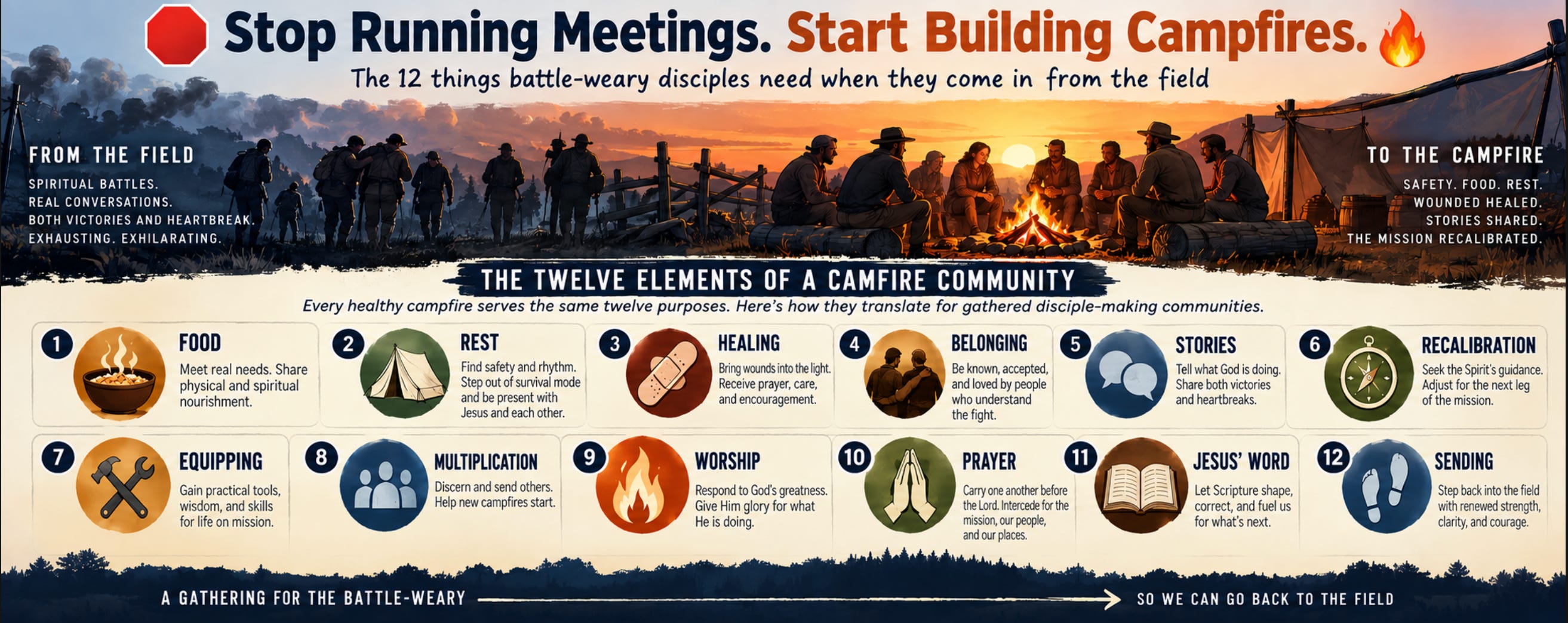
As the evening fell on a Civil War battlefield, those at the camp, the cooks, medics, supply officers, and intelligence gatherers, built large bonfires as beacons. Bright, visible fires that could be seen through the fog of war. Battle-fatigued soldiers who had become disoriented in the chaos of the fight would look up, spot the fire on the horizon, and start walking toward it. Because they were instructed. Because something in them recognized that where the fire was, there was safety, food, rest, and the faces of people who knew what they had been through.
That is exactly what a gathered disciple-making community is supposed to be. It is the beacon fire. It is where the battle-weary come home. It is where wounds are dressed, and stories are told, and the mission gets recalibrated.
So, what does it look like to gather around the safety and resources of the Civil War campfire?
The Twelve Elements of the Campfire Community
Greg’s document identified twelve distinct experiences around a Civil War campfire. These serve a distinct purpose for soldiers returning from battle. I want to walk you through all twelve and show you how they translate into the purpose and practice of your gathered disciple-making communities, whether it’s 3 men in a weekly X-Group or 30 people doing life together in a simple church.
I want you to pay close attention as we go, because this is not a template. This is not an order of service. This is not a checklist you hand to your worship leader. It is a framework for asking the Holy Spirit the right questions so He can design your specific gathering for your specific people.
Every campfire looks different. But every healthy campfire serves the same twelve purposes.
Here is the critical warning before we begin. As you read through these twelve elements, do not default to the models, programs, and patterns of your past. Many of us carry deeply ingrained habits about what a gathering of believers is supposed to look like: small group curricula, worship sets, sermon series, coffee, and donuts.
✔ Some of those things are good.
🚫 None of them is sacred.
Your campfire should look like what your specific soldiers need when they come in from their specific battlefield. Trust the Holy Spirit to show you what that is.

USE DISCOUNT CODE: SUBSTACK for 20% OFF
Or find the Audiobook on Audible, Spotify, or your Favorite e-Book Distributor
Part One: Individual Needs -
What Every Soldier Carries in From the Field
1. Security (shepherd function)
The first thing a soldier felt when he stumbled into the light of the campfire was security. Nobody in that circle was shooting at him. And there were soldiers on the perimeter fulfilling security detail with their backs to the camp and their eyes on the tree lines to make sure no enemies entered the camp.
The people who walk into your gathered community on a Tuesday evening or a Sunday afternoon come in carrying spiritual and emotional weight.
They have been navigating workplaces where their values are mocked. They have been trying to have honest spiritual conversations with neighbors who are outright hostile. Some of them have been fighting internal battles that nobody knows about. When they walk into your campfire, they need to know they are safe.
A soldier who doesn’t trust the people around him cannot let his guard down enough to sleep, eat, receive first aid, or hear the battle briefing. If there is no genuine security, no real confidentiality, no culture of grace, no sense that vulnerability will be honored rather than weaponized, your people will stay guarded.
The question you must ask your community is: What does security look like for the specific people God has gathered? What threats, spiritual, emotional, intellectual, relational, do they carry in from their particular battlefield? And what does it look like for this community to create an environment where nobody is shooting at each other? That could be more difficult than you think. Especially in spiritual cultures of comparison, competition, and distrust.
2. Food (teacher function)
After security came food. And everyone was hungry.
One of the most overlooked practices in the New Testament church is that they ate together. Not as a strategy for increasing group attendance. They shared meals because they understood something that the Western church has slowly forgotten. Food is communal, food is incarnational, food slows people down, food removes status distinctions, and food creates the conditions for real conversation.
In your gathered community, food means two things. It means actual, physical food. Something happens around a shared meal that does not happen when people sit in rows facing the same direction. When Acts 2 tells us that the early church broke bread together, it was not exclusively a reference to the Lord’s Supper. They were eating together. Regularly. In homes. Around real tables.
But it also means spiritual food, the equipping, teaching, and truth that your people need to go back into the battle with more understanding and more skill than they came in with. The question is not whether to feed your people spiritually. The question is what they need to be fed, who should do the feeding, and how it should happen. Not every campfire needs a forty-five-minute lecture. Sometimes the most nourishing spiritual food in your community will come from the least expected voice around the fire.
“What is the outcome, then, brothers and sisters? When you assemble, each one has a psalm, has a teaching, has a revelation, has a tongue, has an interpretation. Let all things be done for the edification of others.”
- Paul in 1 Cor 14:26 (NASB)
3. First Aid (shepherd and prophet function)
Company surgeons patched wounds. They cleaned infections. They set broken bones. They did not ask whether the soldier deserved to be treated, they treated him, because a wounded soldier in the field is a liability to the whole mission.
Some of the people in your gathered community are not going to show up healthy. They are going to show up bleeding. Maybe from an old wound that never fully healed. Maybe from something fresh that happened this week. Marriage trouble. Depression. Addiction. Grief. Spiritual attack. Disillusionment. The residue of a childhood that left deep damage in places they haven’t even been able to name yet.
Your community is not a hospital. But it should have the equivalent of a field surgeon, somebody who knows how to apply pressure to a wound, recognize when professional help is needed, and create enough safety for people to admit they are hurt at all. The “59 One-Anothers” in the New Testament are a first-aid manual for the community. Bear one another’s burdens. Pray for one another. Restore one another.
One of the most practically important things you will ever establish in your community is this: it is okay to be wounded.
You will not be judged. You will be cared for. And you will be expected to eventually get back up and get back in the fight, but not before you are ready, and not before your wound has been dressed.
Part Two: Community Development -
What Happens as the Fire Burns
4. Unwinding (shepherd and evangelist function)
There was a period after the soldiers arrived and sat down around the fire. The adrenaline drained away. The hypervigilance of the battle began to release its grip. Bodies started returning to their natural rhythms. Maybe some laughter about something that happened. Maybe long stretches of silence that didn’t need to be filled.
This is something most of our gathered communities are terrible at. We are addicted to productivity. We fill every moment with content. We treat silence as a problem to be solved and unstructured time as a waste of the meeting. We start exactly on time and end exactly on time because we are efficient, and there is a plan to get through.
And in doing so, we rob our people of the single most important social lubricant in the entire gathering: the chance to be themselves before the meeting officially starts.
Unwinding is not wasted time. If your people don’t have time to shed their public persona and settle into the safety of the campfire, they will carry their armor through the entire gathering. And armored people do not tell stories, cannot receive first aid, and will not honestly engage with accountability.
Build unwinding into your gathering intentionally. This might look like the first twenty minutes over food. It might look like always starting with genuine, unhurried catching up. It might look like a practice of sitting with a question for a few minutes before anyone speaks. However you do it, create the conditions for your people to arrive fully, not just physically, but emotionally and spiritually present, before you move into the deeper work of the gathering.
5. Camaraderie (shepherd, prophet, and evangelist function)
Camaraderie is what happens when unwinding deepens. As the soldiers looked around the fire, they noticed who was there and who wasn’t. They were bound together not by compatibility but by shared suffering. They had been in the same fight. They had seen the same things. And out of that common experience came a bond that was, in many cases, the deepest human connection any of them had ever known.
This is what Paul is describing in Philippians 1 when he talks about his partnership with the church there, a deep bond forged in the shared mission of the gospel. Not a casual social relationship. Not a friendly acquaintance you see once a week. A band of brothers and sisters who have each other’s backs, who celebrate together when there is victory, and who mourn together when there is loss.
The hard truth about camaraderie is that you cannot manufacture it with an icebreaker. It is forged in shared mission. When the people in your gathered community are actually doing the work together, serving in the same neighborhood, and celebrating when someone they have all been praying for comes to faith, camaraderie builds naturally. It is a by-product of commission.
6. Stories of the Day (apostolic and evangelist functions)
This is one of my favorite elements and one of the most distinctively countercultural practices you can build into a gathered disciple-making community.
Around the Civil War campfire, soldiers told the stories of their day. Not sanitized reports. Not polished presentations. Raw stories, tales of courage and cowardice, of moments of grace and moments of failure, of things that happened on the battlefield that they couldn’t fully process alone. These stories served a dual purpose: they knit the community together through shared narrative, and they helped each soldier make sense of his own experience by placing it in the larger context of the mission.
In your gathered community, stories are everything. When someone shares that they had a gospel conversation at work this week that went somewhere unexpected, that story does something in the room that no sermon can replicate. When someone admits that they chickened out of a conversation they knew they should have had, and the room responds not with judgment but with recognition and encouragement, that is formative. When someone shares that the person they have been praying for six months just asked to know more about Jesus, that story becomes the fuel that sends everyone else back out into their oikos the next day with renewed fire.
Make space for stories. Ask for them. Protect them. Celebrate them. And teach your people to recognize that even the hard stories, the conversations that didn’t go well, the weeks when they felt like they were failing at the mission, are stories worth telling, because the Spirit of God is as active in our confusion as in our clarity.
Is this article helpful? Give me a tip to support my work.

Part Three: Leadership Influence - The Captain’s Role at the Campfire
The next three elements represent a shift in the campfire dynamic. The first six were primarily receiving and being together. These three concern leadership doing its work within the gathered community. They require someone in the gathering who serves as a guide. Someone who is paying attention.
7. Reports of the Day (apostle and teacher function)
After the stories wound down, there was a shift. The camp captain began asking questions. Where were you positioned? Did you hold your ground? What happened when the line broke? This was the debrief. It was accountability built into the rhythm of gathering.
I want to push back against the discomfort that many of us feel with accountability in our gathered communities. We have so overcorrected against legalism that we have swung to the opposite extreme, where real accountability is treated as judgmental and personal questions about obedience are considered invasions of privacy. The result is a community that checks in on how people are feeling but never asks whether they are doing what they said they would do.
The Three-Thirds model (find it at disciplemakingcollective.com) is a built-in accountability structure. The first third, Look Back, asks the same question every gathering: Did you do what you said you would do? Not as a guilt trip. Not as a performance evaluation. As a discipleship rhythm. Disciples who know they will be asked next week whether they followed through on their commitment are more likely to do so. Not out of fear. Out of the holy pressure of being genuinely known by people who genuinely care.
The Reports of the Day element of your gathered community is the moment when the leader creates the environment for honest accounting. What did you try? What happened? Where did you see God move? Where did you miss it? What patterns are emerging? What is the Spirit saying through the collective reports of everyone around this fire?
8. Re-Directing (apostle and teacher function)
Based on the reports, the captain re-directed. He told his soldiers which ground would be taken tomorrow. Which direction to move. This was the essential leadership function of translating the larger battle plan into actionable next steps for specific soldiers in a specific position on a specific day.
Re-directing in a gathered disciple-making community is the art of helping your people see what is next for them personally, not generically, but specifically. It answers questions like, based on what you just shared about your conversation with your neighbor, here is what I think you should try next. Or, based on the pattern I’m hearing across multiple people’s stories, I think the Spirit might be highlighting something our whole community needs to pay attention to. Or I’ve noticed that three people in this gathering are in the exact same stuck place. Let’s talk about that together.
Good re-directing requires attentive listening. You cannot re-direct someone if you have not truly heard where they are. This is why shepherds and prophets in a gathered community are so critical, paying attention not just to what is being said, but to what is underneath what is being said. This is a skill. It is developed through practice and through the discipline of asking the Holy Spirit for discernment in every gathering.
9. Re-Arming (teacher, prophet, shepherd, evangelist, and apostle function)
Empty cartridge pouches were refilled. Broken weapons were replaced. Rations were re-supplied. The soldiers did not leave the campfire the next morning with the same depleted resources they brought in. They left equipped. Re-armed. Ready for the next engagement.
This is the teaching, equipping, and tool-deployment function of the gathered community. And I want to be very specific about what re-arming is not: it is not passive information transfer. It is not sitting through a lesson and hoping something sticks. Re-arming means leaving with something you can use tomorrow.
The Disciple-Making Collective has built a toolbox for exactly this purpose, B.L.E.S.S., the Prayer Map, the Three-Minute Story, the 21-Day Disciple Challenge, the SOAPS devotional method, the Gospel icons (all found at disciplemakingcollective.com). Re-arming in your gathered community means identifying which tools your people need for their specific mission contexts and making sure they leave the gathering knowing how to use them.
The intelligence officers in the Civil War rear echelon did not just hand out ammunition randomly. They analyzed what had happened in the battle and resupplied accordingly. In the same way, the best equipping in a gathered disciple-making community is not a pre-determined curriculum that marches through the same content regardless of where the people are. It is responsive (just-in-time vs. just-in-case). It is earned by listening to the Reports of the Day and asking, “What do these soldiers need to fight better tomorrow?”
Part Four: Individual Responsibility -
What Each Soldier Owes the Mission
The final three elements of the campfire represent a shift from what the community provides to what the individual is personally responsible for. This is critical, the campfire is not designed to create dependent disciples. It is designed to create deployed disciples.
10. Rest (disciple’s responsibility)
The soldier who stayed up all night carousing was not ready for battle the next morning. Getting adequate rest was his personal responsibility. The campfire provided the conditions, but the choice to sleep was his.
There is a Sabbath theology embedded in this element that the Western church has almost entirely lost. We have confused busyness with faithfulness and productivity with fruitfulness. We have built disciple-making cultures that burn people out and then wonder why they disengage. The truth is that the most fruitful disciple-makers I know are the ones who have learned to rest, who understand that their effectiveness in the mission is directly tied to their ability to disengage from it regularly and trust God to keep working when they stop.
In your gathered community, this might look like celebrating Sabbath together. It might look like asking each other: How are you sleeping? How is your margin? Where is your rest coming from? Have you done your half-day of prayer this month? It might look like having an honest conversation in your community about the difference between missional urgency and burnout and creating permission that allows people to pull back when they are depleted.
A soldier who refuses to rest is a liability. So is a disciple-maker who never stops.
11. Return to Battle (disciple’s responsibility)
Any soldiers still lingering around the campfire late the next morning were out of place. It was not the sergeant’s job to drag them back to the front lines. It was their own responsibility to return to battle.
This is one of the most important and most neglected implications of the campfire metaphor. The gathered community is not the destination. It is the launching pad. The fire is not where the mission happens. The fire is where you get ready for the mission to happen everywhere else, in your oikos, in your neighborhood, in your workplace, in your city.
One of the great failures of institutional church culture is that we have made the gathered meeting feel like the main event. Show up on Sunday. Sit in a row. Consume some content. Leave. The mission is what the professionals do. The rest of us are audience members.
In a campfire community, every person knows they are a soldier, and that soldiers go back to the front. The gathering exists to improve the scattering. The fire exists to heat the coals, so they burn hotter in the field. And healthy gathered communities hold each other accountable not just to gathering well, but to scattering intentionally.
Some of the most important conversations you will ever have in your gathered community are not about spiritual content. They are about this: Who are you going back to? What are you doing tomorrow in your oikos? What is the specific next step you are taking this week in the mission? Name it here, in front of these people, because these people are going to ask you about it next time we gather.
12. Flexible Expectations (everyone’s responsibility)
The final element of the campfire is perhaps the most underrated. The battle lines were never in the same place twice. The ground that was held today might be lost tomorrow. The enemy moved. The situation changed. And soldiers who returned to the exact same position, expecting to fight the exact same battle, were in danger of fighting an engagement that no longer existed.
Disciple-making communities that become rigid, having found what works and refusing to adapt, are fighting yesterday’s battle. The spiritual landscape of your mission field is not static. The needs of your people change. The neighborhood shifts. The cultural moment evolves. New people arrive at the campfire who need things that your current gathering doesn’t yet provide. Old soldiers go out and start new fires.
Flexible expectations mean holding your format loosely. It means being willing to ask, regularly, whether the way you are gathering is still serving the mission or whether it has become the mission itself. It means being a community that follows the Holy Spirit rather than a community that manages a program. And it means building into your gathered culture enough theological and relational flexibility to change when change is needed, without losing the core purpose of the campfire, which never changes.
They devoted themselves to the apostles’ teaching and to fellowship, to the breaking of bread and to prayer. Everyone was filled with awe at the many wonders and signs performed by the apostles. All the believers were together and had everything in common. - Acts 2:42-44
The Wineskin Question
Jesus said that new wine requires new wineskins. He was not condemning old wineskins. He was warning against the mistake of pouring the living, dynamic movement of the Spirit into containers designed for a different season and context.
Your X-Group, Discipling Community, or simple church may not last forever! Remember Sacred Vibez? It had a season and a life cycle. This is a very hard reality for our traditional church culture to accept. Not even one of those churches in the New Testament still exists today! But the Kingdom of God still advances aggressively. Be at peace when your group’s life cycle may be coming to an end, but disperse strategically, multiplying disciples as you go.
The twelve elements of the Civil War Campfire are the wine. The gathered form of your specific community is the wineskin. And the critical thing about a wineskin is that it must be flexible enough to expand when the wine is fermenting, or it will burst. It must know when it can no longer hold the new wine, or it will become useless.
Greg Getz and his collaborators were trying to do something both simple and profound when they put this document together. They were trying to answer the question that every disciple-maker eventually has to face, if we’re not trying to build what traditional church has built, what are we building? What is the gathered community supposed to look like?
What is it supposed to do? And how do we know if it’s working?
The campfire metaphor is one answer. And it has become mine. A healthy gathered community looks like a Civil War campfire. It is the place where battle-weary soldiers find security and food and first aid. It is the place where the bonds of camaraderie are forged through shared suffering and shared story. It is the place where leadership does the work of honest accountability, re-direction, and re-arming. And it is the place where every individual is reminded that they are a soldier, that the campfire is not home, that the battle is the point, and that they carry the responsibility to return to it.
Acts 2:42 is not a model to be replicated. It is a clue to be unpacked. The apostles’ teaching, that is, the food and the re-arming. The fellowship, that is, the camaraderie and the unwinding. The breaking of bread, that is both the physical food and the security of the shared table. The prayer, that is the ongoing posture of dependence on the One whose campfire this is.
But Acts 2 leaves most of the practical details intentionally unresolved. Because those details vary for each gathering. They are the domain of the Holy Spirit, working through the specific people, in the specific place, for the specific mission He has authored.
A Practical Exercise Before You Move On
The campfire document includes a strategic exercise for you, whether you are currently leading a gathered community or simply dreaming about what one might look like in your future.
Take a piece of paper and draw a line down the middle. On the left side, write out all twelve campfire elements with a brief definition of each. On the right side, write the honest answer to this question: What would this look like for the specific people God has put in my life?
What does security look like for a gathering of young professionals in an urban neighborhood who are suspicious of religious institutions? What does food look like for a community of blue-collar families who don’t have a lot of patience for formal teaching structures? What does re-arming look like for a group of first-generation believers who don’t yet have a strong foundation in Scripture?
Do this exercise as a spiritual practice, not just a planning exercise. Bring the Holy Spirit into it. Ask Him to show you things about your people that you might be missing. When you are finished, you will have something far more valuable than a program. You will have a Spirit-led portrait of the gathered community God is inviting you to build.
