

The Bible has a few incredibly powerful principles so impactful that we can pull them out and proclaim them as world-changing. We are so enamored by their simplicity and strength that we simply call them GREAT.
The Great Commission
Go and make disciples of all nations, baptizing them in the name of the Father and of the Son and of the Holy Spirit, and teaching them to obey everything I have commanded you. - Matthew 28:19-20The Great Commandment
Love the Lord your God with all your heart and with all your soul and with all your mind. This is the first and greatest commandment. And the second is like it: ‘Love your neighbor as yourself. - Matthew 22:37-39The Great Rule
Do to others whatever you would like them to do to you. -Matthew 7:12The Great Target
You will be my witnesses in Jerusalem, and in all Judea and Samaria, and to the ends of the earth. - Acts 1:8
But, there is one GREAT that we often miss that teaches us about God’s strategy for how He intended (and intends) His Kingdom to multiply throughout planet Earth! And without it, we’ll slow down and miss the exponential power of disciple-making multiplication!
Ephesians 4:11 lists the five distinct functions God gives His Church through the leaders He calls to equip: Apostle, Prophet, Evangelist, Shepherd, Teacher.

Take My APEST Assessment for Free at thegreatteam.org
APEST. The five-fold ministry.
Call it what you want, it’s not a hierarchical org chart. It’s not a structure where one leader has the authority and power to call all the shots. It’s the skeleton of a servant-leader team of ministers bound together to fulfill the Great Commission. It’s the Kingdom DNA of every healthy disciple-making community and movement that God puts together to reach and unreached people groups and lead them to full disciple-making maturity. This team was designed to function as one under the headship and authority of Jesus Christ.
And guess what? You can’t get that beautiful expression of faith family that is described in Ephesians 4:12-16 UNLESS you have a full expression of these equipping gifts represented in your ministry team. They work together to equip the saints for the work of the ministry and take beachheads among people groups in the places where we live, learn, work, and play!
How Does This Great Team Function?
For this team to work together, it’s important that each member knows their God-ordained function. There are a ton of assessments and tools. As a matter of fact, I built my own at thegreatteam.org (click to take it). But with all those tools, here’s the picture that finally made it click for a lot of people in our disciple-making network.
A simple grid.
Two questions.
Four quadrants.
One Cross in the middle.
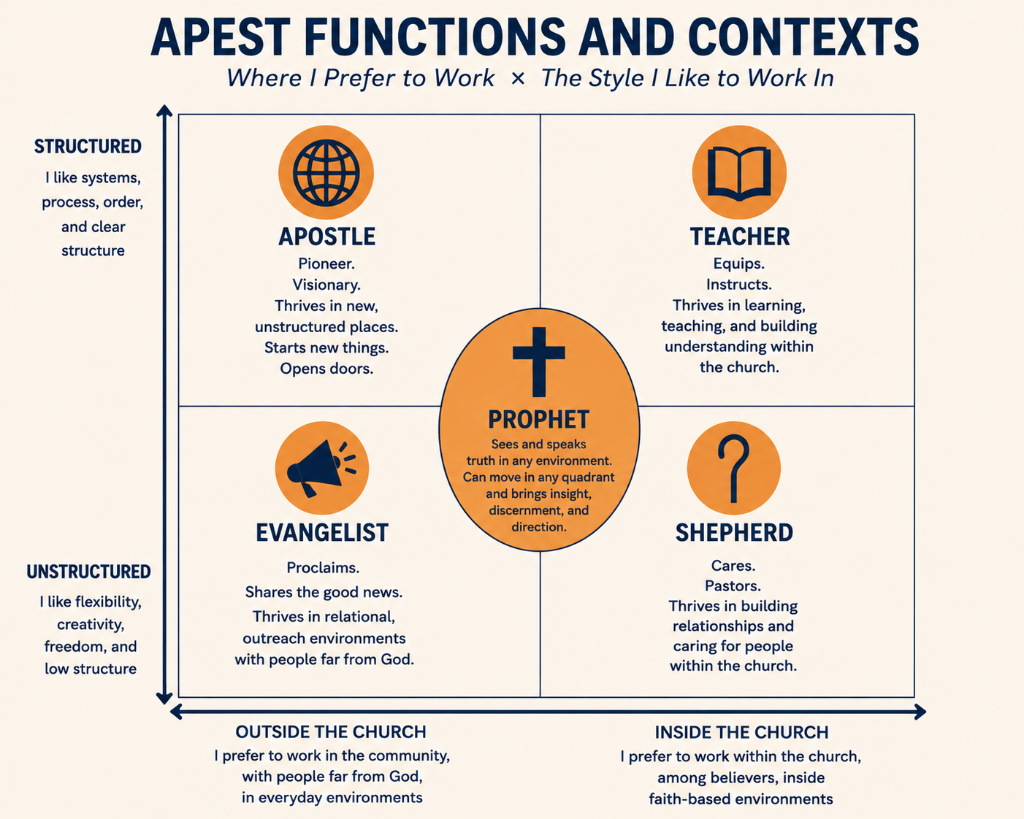
Where do you prefer to work? Outside the church or inside the church?
How do you prefer to work? Structured or unstructured?
Plot those two questions on a graph, and suddenly the five functions stop being abstract theology and start being a map to your specific “GREAT TEAM” function in your mission field.
Two Ways to Read Ephesians 4:11
There are two ways to read that verse, and the one you choose determines whether APEST becomes an interesting theological footnote or a transformational framework for how you build a disciple-making team.
You can read it as a list of job titles. Apostle, Prophet, Evangelist, Shepherd, Teacher.
✅ Box checked.
🏃♂️ Moving on.
Or you can read it as a mission architecture. Five distinct, irreplaceable functions that together produce the full picture of the mature, multiplying leadership community we read about in Ephesians 4:11-16.
Learn more in My Book
“Hand to the Plow: The Field Guide for Everyday Disciple-Makers.”
Click HERE or the image below and
Discount Code “SUBSTACK” for 25% off!

💥 Here’s the key shift💥
The APEST is not describing five types of professional ministers. These are not roles to be filled on a staff org chart. Verse 11 describes a leadership team representing five kinds of Kingdom DNA that exist in every healthy disciple-making community. The community best reflects the Kingdom of God when all five are present and active, not when they’re all crammed into a senior pastor’s job description.
🤯 And not when only two of the five ever get developed because they’re the ones that make Sunday morning run smoothly.
Think of it this way. A body needs more than one organ to function. A lungs-only body would not last long. A heart-only body would not get far. The body works because every system is present, connected, and doing its part. The APEST is the organic, Spirit-given ministry anatomy of leadership in a community of disciples. The APEST functions best when the church is on the move, both gathered AND scattered. And each of those five functions plays a 💪POWERFUL role in both spaces.
❓The real question is whether we’re developing all five, or just the two that make our Sunday morning wheels keep spinning.
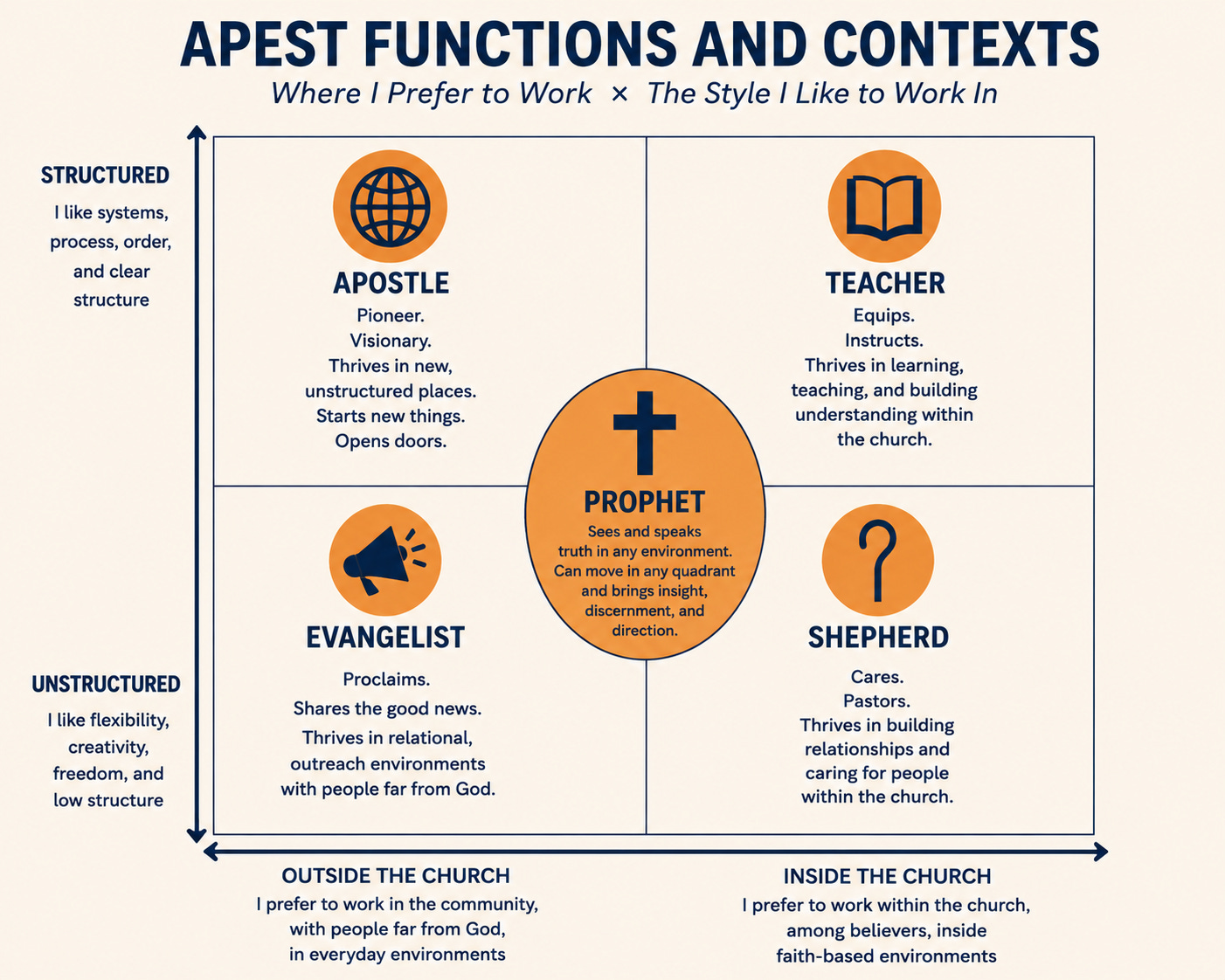
The Four Quadrants
In this diagram, there are four quadrants. The X-axis represents whether a person thrives outside or inside the church walls. So the left half of our quadrant represents outside, while the right reflects those who prefer to work AMONG the believers. In other words, are you a gathered minister or a scattered minister?
The Y-axis represents whether you operate in a more structured pathway or if you prefer to work spontaneously and unstructured. Do you create pathways or operate in one-off relational encounters?
So let’s meet the team, and let’s put them on the map.
Top Left: The Apostle: Structured + Outside the Church.
The word apostle comes from the Greek apostolos, meaning “one who is sent.” The sent-ness is the whole point. The Apostle is the boundary pusher. 🤠 The pioneer. The person wired to look beyond what already exists and ask, “What is God doing over there, and how do we get there?”
They are missional visionaries by nature, drawn toward unreached people, uncomfortable with the status quo, compelled to expand the Kingdom into spaces where it does not yet exist.
The question the Apostle answers is: Where is the Kingdom not yet, and what do we need to do to take it there?
Apostles see what is possible before anyone else does, and they have the courage and catalytic energy to go first. They see forests, not trees. How do we reach this city? And they think in movements, not maintenance.
They also have a God-given ability to connect different parts of the Body with one another; Paul wasn’t just planting churches; he was building a network of churches that served and strengthened one another.
💥 But the same drive that makes Apostles extraordinary pioneers can make them difficult teammates. They get frustrated with anything that feels like it’s slowing the mission down, which, in their view, is almost everything. They can leave a trail of unfinished things behind them in the rush toward the next frontier, and they can undervalue the shepherding and teaching that keep the people they launch connected and maturing.
Without the Apostle, a team turns inward.
The mission shrinks.
The community starts serving itself instead of expanding the Kingdom.


Top Right: The Teacher — Structured + Inside the Church.
This is the one who grounds everything in the Word. [Grk. didaskalos] one who instructs others in the truth of Scripture.
The Teacher can accurately handle the word of truth, break down the fundamental truths of the Bible, and communicate them in a way disciples can both understand and apply, moving people toward mature faith. They also protect the community from false teachers who show up with their own agenda.
An Apostle with a strong theological foundation is a far more sustainable pioneer than one flying on vision alone. A Prophet grounded in Scripture is far more discerning than one whose impressions answer to no one. The Teacher is what adds that balance to the whole team.
👀 But Teachers can mistake information for transformation. Explaining a passage is not the same as leading people to obey it, and their deep respect for tradition can calcify into a reflexive resistance to anything unfamiliar, exactly when a fast-moving Apostolic team needs to try something new.
Without the Teacher, a community becomes vulnerable to theological instability, falls into personality-driven leadership, or chases shallow “movement energy” that eventually burns out or goes off the rails.
Bottom Left: The Evangelist — Unstructured + Outside the Church.
This is the one who can’t sit still while people are far from God.
They proclaim.
They share the good news.
They scatter gospel seed into every relational soil they can find, and they thrive in unstructured, organic, outreach-shaped environments. They run ahead of everyone else, leaving a trail of gospel seed scattered everywhere, sometimes without sticking around to see what grows. Sometimes they seem flaky, or overly radical, or embarrass the rest of us by their boldness in public. Maybe they lead someone to the cross and then leave them in the dust.
Is that irresponsible?
Or is it by design?
When the Evangelist goes silent in a community, the mission has drifted inward. When they speak up, they’re calling everyone back to why we exist in the first place. Don’t silence that missionary heartbeat.
Listen to it.
Bottom Right: The Shepherd — Unstructured + Inside the Church.
This is the nurturer and the caregiver.
Shepherds love that bottom-right quadrant where they can nurse and nurture one sheep at a time, leaving the ninety-nine and rescuing the one lost and wounded in the trenches, nurturing that sheep back to health and returning it to the fold, just in time to rescue another.
That’s the gift everyone loves, until they realize the Shepherd has loved the flock into a holy huddle that forgot the world exists, or has failed to speak hard truth because their compassion overshadowed their truth-telling.
When the Shepherd goes silent, you’ve lost the heart of the mission. Don’t dismiss the compassionate heartbeat.
Listen to it.
The Center: The Prophet
Now look at the middle of the grid. Not a quadrant, a crossroads.
That’s the Prophet.
The Prophet doesn’t care about your categories. They couldn't care less about being inside or outside the church, or proclaiming to the whole flock, or sitting with one sheep at a time.
Prophets are only concerned with one thing: whether the whole forest and sheep pen are aligned and submitted to the Word and Will of God. They keep things from drifting.
The Prophet can move into any quadrant, in any context, and ask the one question nobody else wants to ask: Is this actually what God said, or is this just what’s working right now?
That’s why the graphic puts the cross of Christ right at the Prophet’s center. Every function answers to the same Lord. The Prophet just refuses to let anyone forget it. And let’s kill the bad teaching right now, the Prophet isn’t a fortune teller or a doom-and-gloom guy in the corner. The Prophet is the one who sees and speaks truth in any environment, bringing insight, discernment, and direction wherever they go.
Of the five, this is often the most misunderstood and silenced, usually because it makes everyone nervous in meetings.
❤️🔥 But when they speak, the mission gets realigned.
Pathways, Trees, and Forests
Here’s a dynamic to pay attention to, because it shapes everything about how a real APEST team functions together.
About 80% of the believers you’ll encounter are not designed to create disciple-making pathways. They’re not wired to see the forest. They’re gifted at seeing and engaging the trees and the sheep,
the individual people,
the specific conversations,
the one-on-one relationships that make up the actual substance of the mission.
They need someone to cut a pathway through the forest. They need someone to create reproducible tools that give all that individual-level engagement direction, structure, and a destination. They need someone to answer the question: “Where are we going, and how do we get there together?”
That’s the apostolic function, not just pioneering new territory, but creating clear, reproducible trails into that new forest. Not just casting vision, but building the road that makes the vision accessible to the 80% who are ready to walk it but cannot yet see it on their own.
Put the whole team in the forest together, and it looks like this: the Apostle sees the forest. The Prophet listens to which direction the wind of the Spirit is blowing. The Evangelist sees the trees. The Shepherd keeps bandages on the sheep. And the Teacher makes sure the flock doesn’t get lost in the theological underbrush.
You need all five.
Most disciple-making communities that are struggling are struggling because nobody has created a clear pathway, everybody is in the trees. And without a pathway, even the most gifted tree-level workers eventually get disoriented and discouraged.
Why Most Disciple-Making Teams Stall
Most disciple-making teams stall,
🚫 Not because the people in them don’t love Jesus
🚫 Not because they aren’t working hard, not because the vision isn’t compelling,
🚫 And especially not because they lack gifted leaders.
They stall because the team is structurally incomplete.
Some of the gifts are functioning, while others are absent, underdeveloped, or actively suppressed.
And the parts of the Body that are missing cannot simply be compensated for by working harder with the parts that remain.
Paul was explicit about this in 1 Corinthians 12.
👁️ If the whole body were an eye, where would the sense of hearing be?
👂 If the whole body were an ear, where would the sense of smell be?
Every member is essential. Not every member is interchangeable.
A body that is missing members or treating certain members as unnecessary is operating at a fraction of its potential.
What does a broken body look like?
Here’s how it usually plays out.
🤕 A team led by Apostolic and Evangelistic voices expands rapidly, starts lots of things, reaches new people, but leaves a trail of relationally wounded, theologically confused, spiritually un-tethered disciples behind them.
⚠️ A team led by Shepherding and Teaching voices produces genuinely cared-for, well-grounded disciples who never actually go anywhere. The community turns inward, the front door quietly closes, and in five years, they’re a very mature club of already-convinced believers.
🔥 A team without a prophetic voice simply drifts. The prayer life becomes perfunctory. The discernment dulls. The gap between what the team is doing and what God is specifically calling them to do widens, and nobody names it because nobody on the team is wired to name it.
Every one of those configurations produces real fruit where their functions are strong. And every one of them fails where their functions are absent.
Picture a neighborhood soccer scrimmage. One team has players who are fast, aggressive, and can all shoot, great athletes, every one of them sprinting toward the ball the moment it’s kicked, leaving the rest of the field wide open.
Nobody holds position.
Nobody sets up plays.
Just eleven kids chasing the same ball.
They lost 7-1.
The other team had one kid who hung back and held the defensive line,
one who orchestrated passes from the middle,
one whose only job was to see the field and communicate,
one natural scorer who got the ball in the right spot every time because the right people put it there.
They won, and it wasn’t even close.
The difference wasn’t talent. It was team.
That’s the picture of every well-meaning, passionate group of disciple-makers running toward the same ball and burning out in the process.
Building a “GREAT TEAM,” Not a Club of One
Most disciple-making teams are not functioning as a genuine team yet. They’re functioning as a collection of gifted individuals who haven’t yet learned to value the functions that are different from their own.
The Apostle is frustrated with the Shepherd for slowing things down. The Shepherd is anxious about the Apostle moving too fast and leaving people behind. The Prophet is waiting for everyone to stop and pray, while the Evangelist is already out the door, meeting the next person. The Teacher is worried that nobody is reading deeply enough, while the Apostle wonders whether the Teacher is overthinking what should be a simple yes-or-no.
Sound familiar❓
Every one of those tensions is real. And every one of them is a gift, not a problem. If we know how to steward and disciple them to maturity.
The Kingdom doesn’t advance through lone rangers and spiritual superstars, but through a unified team: apostles pioneering, prophets discerning, evangelists reaching, shepherds nurturing, and teachers grounding, all five functions working together the way Christ designed them in Ephesians 4:11, so the whole Body is equipped for the whole mission.
We tend to build teams by affinity instead. We find the people who think as we do, who are wired like we are, who share our vocabulary and pace, and we pour our investment into those relationships because they’re comfortable and energizing.
Before long, we’ve assembled a group of people who are deeply aligned, and deeply incomplete. Five Apostolic people in a room is fast, visionary, and a lot of fun. It is also a house with no foundation, no walls, and no roof because the functions that provide them were never invited to the table.
Affinity teams move fast, or reach far, or nurture deeply, or know a lot, or make everybody uncomfortable, but APEST teams are both multiplying and sustainable.
And here’s the good news buried in the tension: the apostle and the shepherd, in productive tension, build communities that both expand and sustain. The prophet and the teacher, in productive tension, build communities that both discern and ground. The evangelist, held in healthy check by the shepherd and the teacher, builds an outreach that is warm, relationally rich, and doctrinally solid.
That tension you’re feeling on your team right now? That’s not a sign something’s broken. That might be the clearest sign something’s actually working.
Know Yourself. But Don’t Stop There.
Every person reading this is wired primarily toward one or two of these five functions. Identifying your primary function isn’t optional; it’s the foundation of healthy team contribution. You cannot give what you do not know you have. You cannot develop what you cannot name. And you cannot build a team around giftings you’ve never clearly identified.

But don’t stop at self-discovery. Knowing about the APEST is not enough. Identifying your primary function and then retreating into your lane misses the whole point. The goal is not to figure out which one you are and operate exclusively out of that function while merely tolerating the others. The goal is to function as a genuine, collaborative, mutually submitting team where every voice is heard, every gift is deployed, and the result is the mature, unified, equipped Body Paul describes in Ephesians 4:12-16.
Jesus himself was not half a team. He pioneered new territory (apostolic). He heard and declared the Father’s word (prophetic). He sought and saved the lost with the message of His relentless love (evangelistic). He laid down His life for His sheep (shepherd). He taught with an authority that transformed lives (teacher). He was the whole team in one person.
But you, friend, are not the savior of the world. You need a team of co-laborers, and they need you.
So What Do You Do With This?
First, find yourself on the grid.
Are you wired for structure or for flexibility?
Inside the walls or outside them?
That’s not a value judgment.
It’s a calling.
Second, stop building your disciple-making team by affinity.
Go find the function you’re missing and invite that person to the table, even when their instincts feel like friction against yours.
The friction is the feature, not the bug.
Third, when the Prophet in your group says something that makes everyone squirm, don’t check your phone. Listen.
They’re not trying to derail the mission. They’re trying to keep it pointed at the Cross, which sits right in the middle of the map.
Hand to the plow, friend.
But know which row you were built to plow, and who else needs to be standing in the field beside you.
❓Where do you land on the grid — structured or unstructured, inside the church or outside it?
❓And which function is missing from your team right now?
✏️ Drop it in the comments. Let’s map this out together.
I am currently attending a small church with my family that has a high emphasis on teaching and shepherding. Slowly I have become discouraged because I feel it has turned into somewhat of a club that meets on Sunday mornings. My husband and I have a heart to evangelize and reach people and have done so by bringing families and neighbors to my home to love them. The church has told us that it is okay for us to do this on our own, but the church is not going to organize any type of program that represents the church? I found this odd. I want to work with them and be a team. I am so discouraged.
Before I read this article I would have thought the apostle was at the center of the grid, but I see it now, and it makes perfect sense prophet being in the center of the grid. Thank you for writing this