

Note: My Substack friend, Jeremiah Kharkovits, published an important book on the faith of many famous historical scientists, supporting the truth that science and faith are not opposed to one another. Here is his overview of the book.
Check out his Substack, platform, The Christian Historian, HERE.
Article by Jeremiah Kharkovits
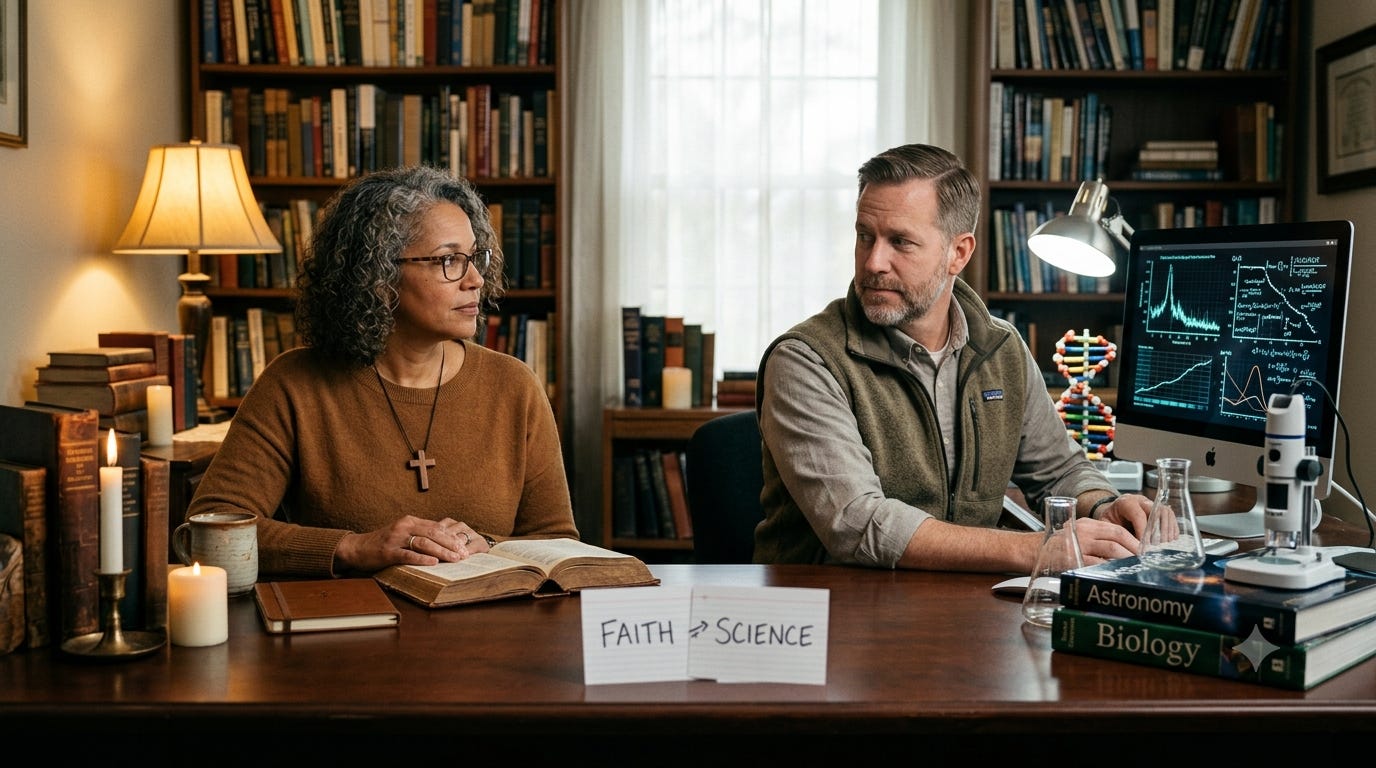
You likely heard the following statement or at least something of the sort: “science and faith are enemies.” This is, of course, not true, but why? And if it’s not true, why does it even matter?
In this article, I plan to unpack that, while also showing that many of the scientists that we know believed in God.
Where It Came From
Before I get to the real juice of the article, it is important to mention when the myth of science and faith being enemies really began. The myth comes largely from two 19th-century books — John William Draper’s History of the Conflict Between Religion and Science (1874) and Andrew Dickson White’s A History of the Warfare of Science with Theology in Christendom (1896). Both volumes paint science as the hero and faith as the villain.
And that thinking is just false.
What The Men That Built Modern Science Believed
In addition to pushing the myth, many secularist individuals make it seem like many of the scientists who shaped modern science agree with their view. Now, this is very simply debunked.
Nicolaus Copernicus was a Catholic canon who dedicated his heliocentric model to the Pope.
Johannes Kepler described his work on planetary motion as “thinking God’s thoughts after him.”
Isaac Newton wrote more about theology than he ever did about physics, or science for that matter.
Robert Boyle, the father of modern chemistry, funded lectures defending Christianity against atheism and left money in his will to keep them going after he died.
Gregor Mendel, the monk who founded modern genetics, ran his pea-plant experiments in a monastery garden. Sounds like they didn’t believe the myth, “science and faith are enemies and cannot coexist,” after all.
Furthermore, other instrumental scientists like Michael Faraday, James Clerk Maxwell, John Ray, Francis Bacon, Lord Kelvin, Blaise Pascal, and others were firm believers in God, while being scientists. Their work built the foundations of modern science.
Then Why Does The Myth Still Exist?
Many people deny the truth and the facts because it either doesn’t fit their worldview, feels uncomfortable, or contradicts what they previously thought. Additionally, men such as Richard Dawkins have promoted the myth to oblivion, which has influenced thousands, if not millions, of people worldwide.
Lastly, when people turn away from God, their understanding and thinking have to fit that, which then leads to the fabrication of myths like, ”science and faith are enemies.”
Why The Truth Matters
Firstly, it matters because a myth is destroyed and a truth is restored.
Secondly, it reframes the relationship from combat to origin.
The conflict myth assumes science happened despite religion. The real history shows science emerged largely because of a Christian view of the world.
Lastly, if the myth is true, then a person cannot have faith and work in science; thus, they have to choose one or the other. Dismantling the myth restores the reality that both can coexist peacefully.
Now, this article isn’t meant to say that all major scientists were Christians or that they all believed in a Creator, but rather that without the work of scientists who were Christians, we would not have modern science.
That’s the story I wanted to tell at length in my new book, The Greatest Christian Scientists, which is the first volume in The Greatest Christians Series.

It walks through the lives of believers like Newton, Boyle, and others who believed in God and so saw no conflict between Christianity and science.
If you’ve ever been told you have to choose between believing in God and thinking seriously about science, I’d encourage you to look at the actual lives of the people who built the scientific method in the first place.
Their lives are more compelling than any argument I could make for them.
Thank you for this. It is well-written and exceptionally clear.