

If you want to dig deeper into the principles and tools of the Disciple-Making Collective, find us HERE. If you want to get the Substack extras of the Premium Network, including FREE COPIES of each of my two books, CLICK HERE.
Today’s Article is an EXCERPT from Chapter 1 of My New Book “Hand to the Plow: The Field Guide for Everyday Disciple-Makers”

Use Discount Code: SUBSTACK for 20% Off!


The Habit of Integration: Making Disciple-Making Part of Things You Already Do
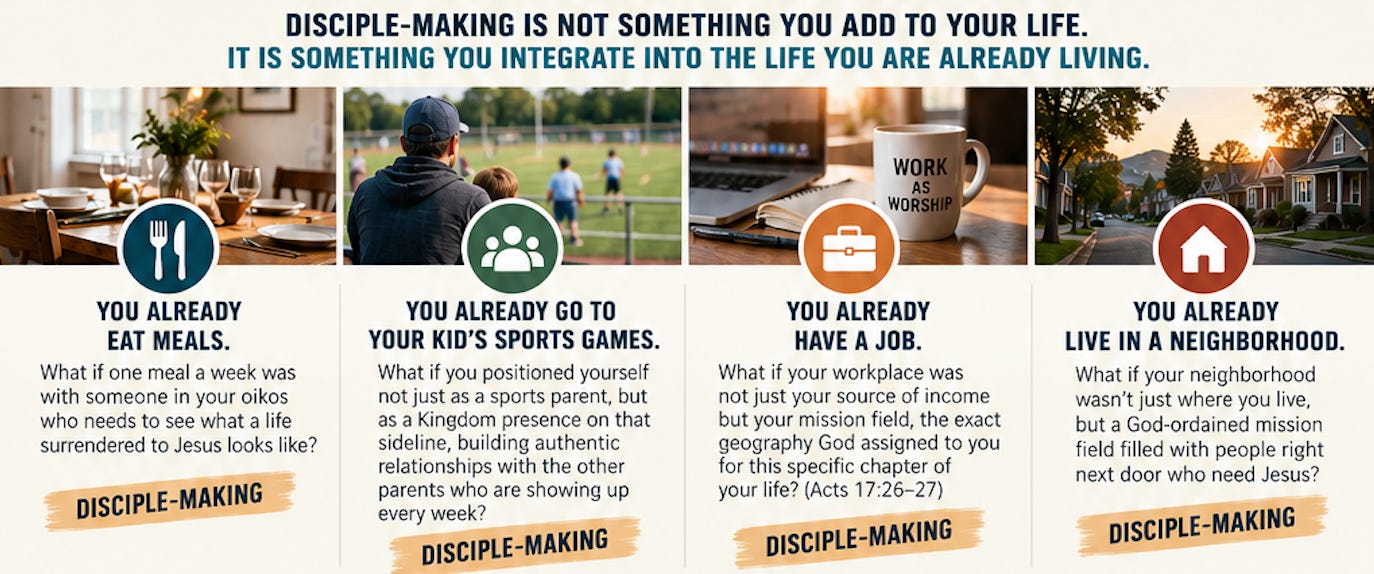
Disciple-making is not something you add to your life. It is something you integrate into the life you are already living.
I know that sounds simple. Maybe even too simple. But stay with me, because the implications of that statement are revolutionary when you follow them all the way through.
✔ You already eat meals. What if one meal a week was with someone in your oikos who needs to see what a life surrendered to Jesus looks like? * DISCIPLE-MAKING *
✔ You already go to your kid’s sports games. What if you positioned yourself not just as a sports parent but as a Kingdom presence on that sideline, aware, available, building authentic relationships with the other parents who are showing up week after week right beside you? * DISCIPLE-MAKING *
✔ You already have a job. What if your workplace was not just your source of income but your mission field, the exact geography God assigned to you for this specific chapter of your life (Acts 17:26-27)? *DISCIPLE-MAKING *
Every one of those moments is already happening.
What changes when you begin to see them through a disciple-making lens?
💥 Everything changes 💥
The great disciple-makers of the New Testament did not have a separate ministry life compartmentalized from their regular life. Paul made tents. And he made disciples. He did both at the same time, in the same workspace, with the same people. He said, “Follow my example, as I follow the example of Christ” (1 Corinthians 11:1, NIV). That is not an invitation to come to a program. It is an invitation to emulate a life being lived.
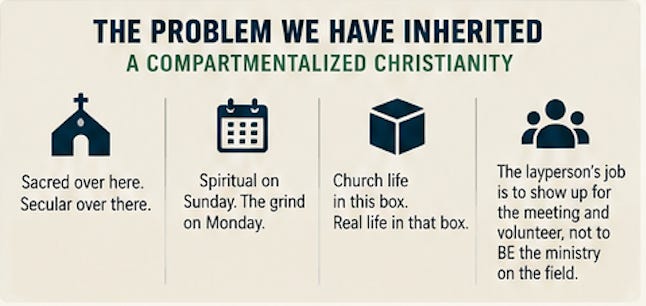
🚫 But that is not what Jesus commissioned. “As you are going.” The call is not to leave your life and go do ministry. The call is to take ministry with you INTO your life.
Incarnate Jesus in your workplace, living space, rat race, and on your public face. - Hand to the Plow, p. 26 by Kevin E Beasley
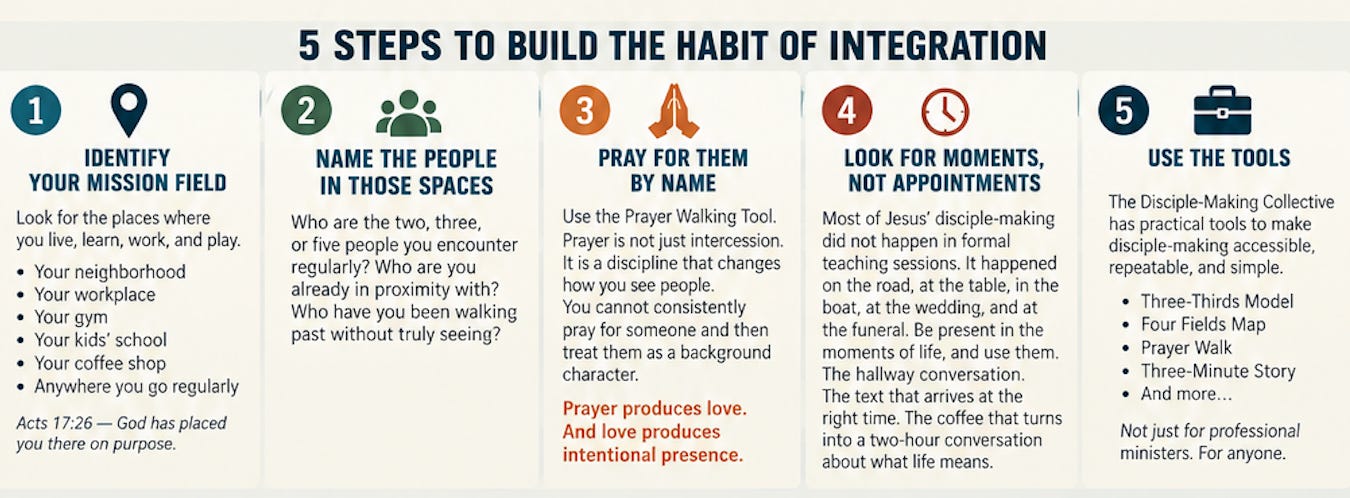
So, what does it look like to build the habit of integration? Let me give you some handles.
First, identify your mission field. In the Disciple-Making Collective, we talk about the places where you 🏠 live, 👩🏻🎓learn, ✂️ work, and ⚽️ play.
Your neighborhood.
Your workplace.
Your gym.
Your kids’ school.
Your coffee shop.
Those are not incidental locations in your week. They are God-ordained mission fields. Acts 17:26 tells us that God “determined the times set for them and the exact places where they should live”, not just so they would exist there, but “so that they would seek him and perhaps reach out for him and find him.”
🎯 Your oikos, your web of relationships, is not an accident. It is an assignment.
Second, name the people in those spaces. Who are the two, three, or five people in each of those spaces who you encounter regularly? Who are you already in proximity with? Who have you been walking past without truly seeing? Disciple-making starts with paying attention to who God has already placed in your path.
Third, pray for them by name. Use the Prayer Walking Tool that we use in the Disciple-Making Collective. This prayer is not just intercession. It is a discipline that changes how you see people. You cannot consistently pray for someone and then continue to treat them as a background character. ❤️Prayer produces love. And love produces the kind of intentional presence that disciple-making requires.
Fourth, look for ⏰ moments, not 📆 appointments. Most of Jesus’ disciple-making did not happen in formal teaching sessions. As I mentioned earlier, as far as we know, He only preached about eight long-form sermons. It happened on the road, at the table, in the boat, at the wedding, and at the funeral. He was present in the moments of life, and He used them. You can schedule time with the people you are discipling, and you should, but don’t miss the organic moments that show up in the middle of ordinary life. The hallway conversations. The text that arrives at the right time. The cup of coffee that turns into a two-hour conversation about what life means.
Fifth, use the tools. The Disciple-Making Collective has adopted a set of practical tools, the Three-Thirds model, the Four Fields map, the prayer walk, the Three-Minute Story, precisely so that the practices of disciple-making are accessible, repeatable, and simple enough that anyone can do them. Not just professional ministers. Not just the seminary-trained. Anyone. These tools exist to lower the barrier and raise the fruit.
The disciple-making life is not a new life. It is your current life, seen through a new set of eyes.
It is Monday morning at the office with Kingdom awareness.
It is Friday night with your neighbors with missional intentionality.
It is Sunday with your kids with the next generation in mind.
The habit of integration does not require a time slot. It requires a transformation of perspective.
The Chapter in a Single Sentence
Disciple-making is not a program you attend or a ministry you perform, it is a lifestyle you embrace, woven into the ordinary moments of your already-existing life, multiplied through deep investment in the few, measured by Kingdom fruit rather than institutional metrics.

A great word and great advice!
You are addressing an issue I have been pondering for some time now. The Lord said, "Follow me and I will make you fisher's of men.". Yet the modern church spends great time and effort in teaching fishing lessons and techniques. Why not spend that time and energy in helping people learn to follow Jesus, and let him make fisher's of men.