

About a year ago, I released Part 1 of this series without expecting an avalanche of responses. Boy, was I naive! That first article was about resources required for the traditional Sunday attractional model of church versus the non-traditional model of simple churches in homes, cafes, coffee shops, and other gathering spaces.
That article took off and created a ton of great discussion and contemplation.
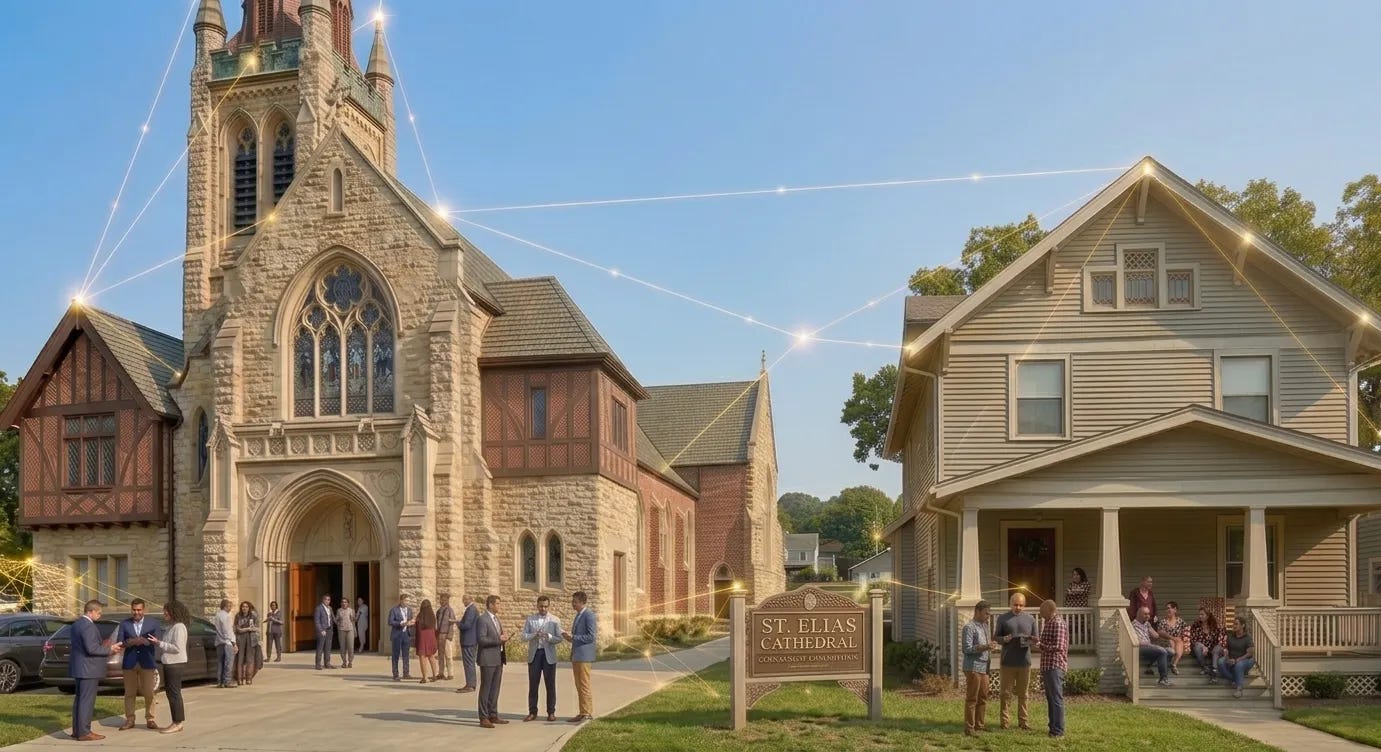
THE SKINNY ON THAT ARTICLE❓
Conservatively, it requires an annual budget of about $3.5 million to run one megachurch of 2,500. That’s about $1,400 per person. Newer studies put it closer to $4.5- $7 million annually.
This is a general breakdown of where that money goes. 1
Staff Salaries and Benefits: 45% to 55% ($1.1M – $1.9M) for pastoral, administrative, and ministry staff.
Facilities and Operations: 20% to 30% ($500K – $1.05M) for mortgages, maintenance, insurance, and utilities.
Ministries and Local Outreach: 10% to 15% ($250K – $525K) for internal programs, youth groups, and community events.
Missions and Charitable Giving: 10% to 15% ($250K – $525K) for external and global missionary support.
Savings and Debt Repayment: 5% to 10% ($125K – $350K) for emergency reserves and capital debt.
🪙 On the other side of the coin, the simple church requires around $40 a person to run a hundred simple churches of around 25 people each. Same reach, richer relationships, simplified model, a fraction of the cost.
Facilities ($0): You use existing living rooms, backyards, or basements. Utilities may bump up slightly, but host families usually absorb this cost.
Food & Fellowship ($20 – $100+ per meeting): This is usually the largest ongoing expense. Many house churches offset this by running potluck-style meals where everyone contributes.
Media & Tech ($0 – $50 per month): You do not need expensive sound systems. Costs may include a Spotify/Apple Music subscription for worship playlists or a streaming license (like CCLI) if you project lyrics.
Curriculum & Bibles ($0 – $100 upfront): Many group studies, reading plans, and discipleship materials are free online. You may occasionally buy physical books or study guides.
Legal & Administration ($0 – $500 upfront): If you choose to formalize as a 501(c)(3) nonprofit for tax-deductible donations, expect state filing fees and accounting software costs (like QuickBooks). Many house churches operate informally without this.
Childcare ($0 – $80 per meeting): Adults often take turns watching children for free. If the space is tight, hiring a local teenager or babysitter is a small collective expense.
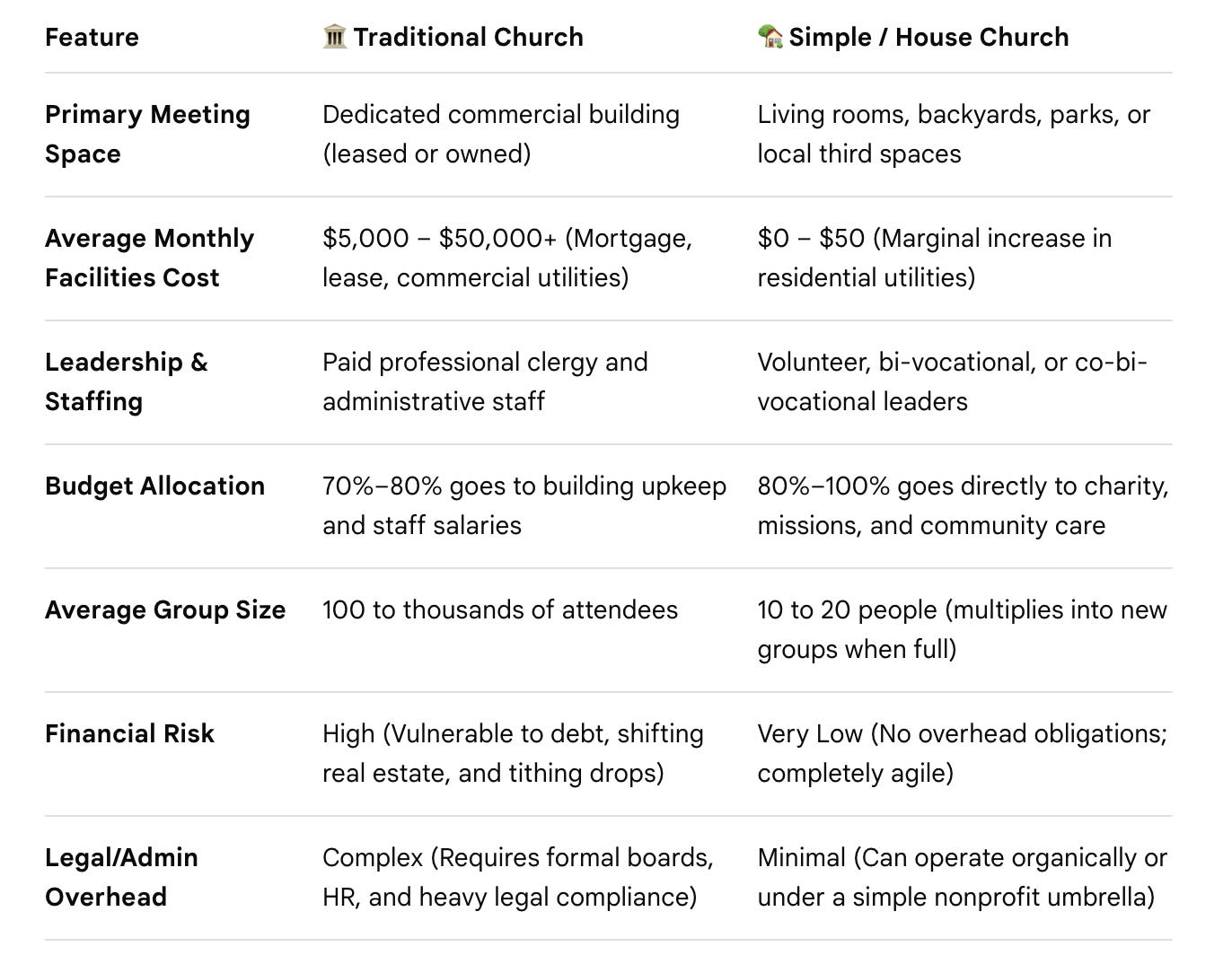
When I was researching the two models, Gemini created this fun table.
⚖️ Traditional vs. Simple Church Costs
Dozens of you wrote back.
🎉 Some of you cheered.
⚠️ Some of you pushed back.
❓And a handful of you asked a question that inspired the second and third installments.
Some honest questions deserved thoughtful answers.
That’s How One Article Became a Series of Conversations!
Click Here to Read Part 1 | Click Here to Read Part 2
Part 2 was about RELATIONSHIPS.
Why twenty-five people multiply faster than twenty-five hundred, and why the 59 one-anothers of Scripture can’t survive in a crowd. Again, popular article with some excellent responses and questions!
Now, it’s time to tackle another honest question.
“If this really is the better way, why does almost nobody do it?”
Fair. Let’s answer it.
I don’t think the answer is money, and I don’t think it’s strategy.
Last week I posted a survey on my platform that asked my readers:
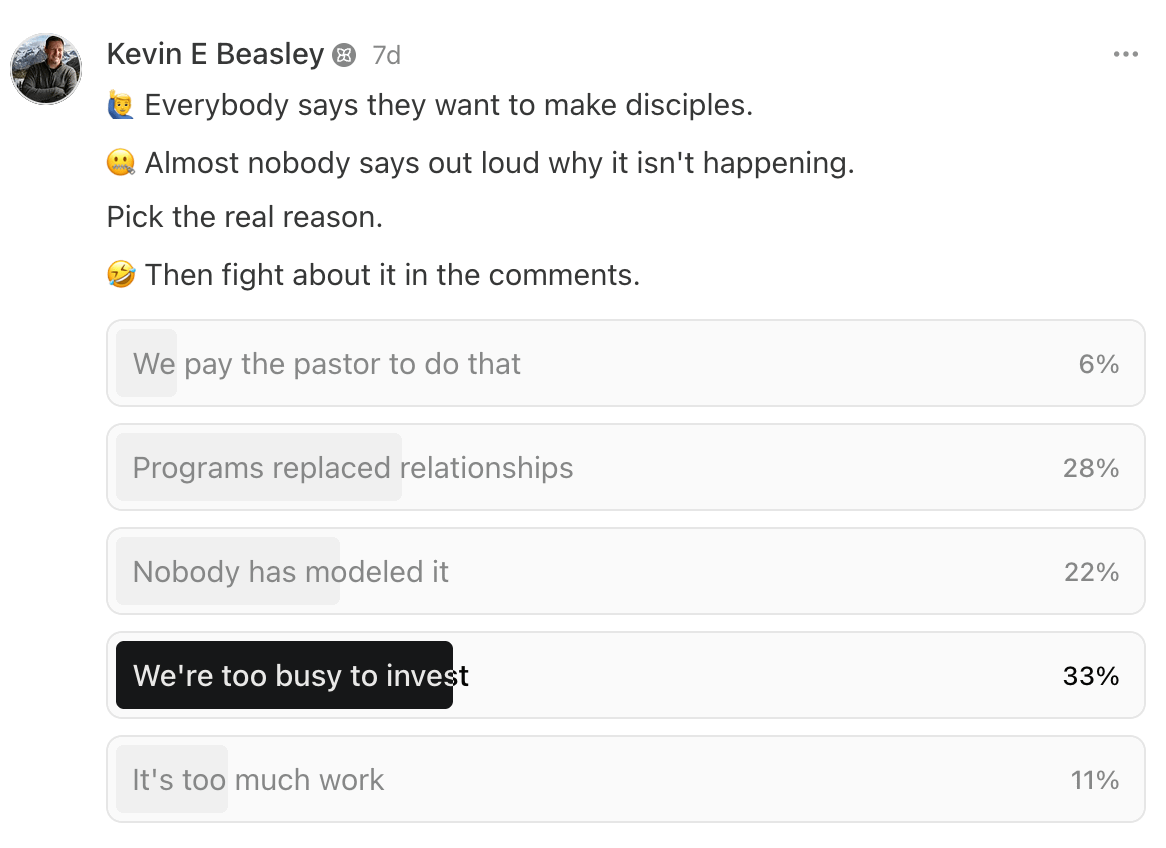
33% of respondents said the reason people aren't making disciples is that they are…
📆 TOO BUSY TO INVEST!
Although that question is a little different from the one we are exploring today, I would bet the farm it would be the same answer. I’m not trying to win an argument today. I’m trying to help you see something hiding in the bushes of the modern attractional church.
Who Actually Got Jesus’ Investment?
Here’s a question worth slowing down for: how many people did Jesus actually spend His life with?
⛪︎ Not preach to.
❤️🩹 Not heal.
🍕 Not feed.
Spend His life with.

Like This Article? Buy Me a Coffee.
When you read the Gospels looking for that, a strange pattern surfaces. Jesus could preach to thousands, and He did. He could have built the first megachurch in human history with a single afternoon of 🥖 loaves and 🐟 fish.
But that is not where He put His hours.
Look at the groups of people Jesus invested in and the amount of his margin they got.
🎯 The three (Peter, James, and John) got ALL of Jesus.
They saw Him transfigured (Matthew 17:1).
They were in the room when He raised Jairus’ daughter (Mark 5:37).
They were with Him in the Garden of Gethsemane on the worst night of His life (Matthew 26:37).
👉 The nine got a lot of Jesus.
Traveling and eating.
Questioning and being questioned.
Trained in the ordinary, unglamorous rhythm of just following Him around.
👉 The seventy-two got some of Jesus.
Occasional teachings
Sent out (Luke 10)
Hard sayings
👉 The crowds got a little of Jesus.
Healing.
Deliverance.
Some bread and fish.
And, as far as we can tell, only about eight long-form sermons.
🤔 Consider this 🤔
If Jesus is our model, and the crowds got the least of His time, why have we built almost our entire church economy around serving the crowd?
I’m not asking that to make you feel guilty.
I’m asking because I built my own ministry life around the crowd for years and never once thought to question it.
❓Have you❓
And notice what Jesus was not limited by. He wasn’t short on resources. He wasn’t short on charisma. He could out-preach and out-heal anyone who ever lived.
He chose the small circle on purpose❗️
So the question isn’t whether we can gather a crowd. Plenty of people can. The question is whether we’re brave enough to do what Jesus did with His busy calendar and limited resources.
The Mantra that Keeps Me Awake
There’s a sentence in my book, Hand to the Plow, that reorganized how I think about all of this. The phrase was introduced to me by Dan Grider of Ignite Disciple-Making Network, and it changed most of how I view ministry, particularly disciple-making and church planting.
💥 More time with fewer people produces greater results
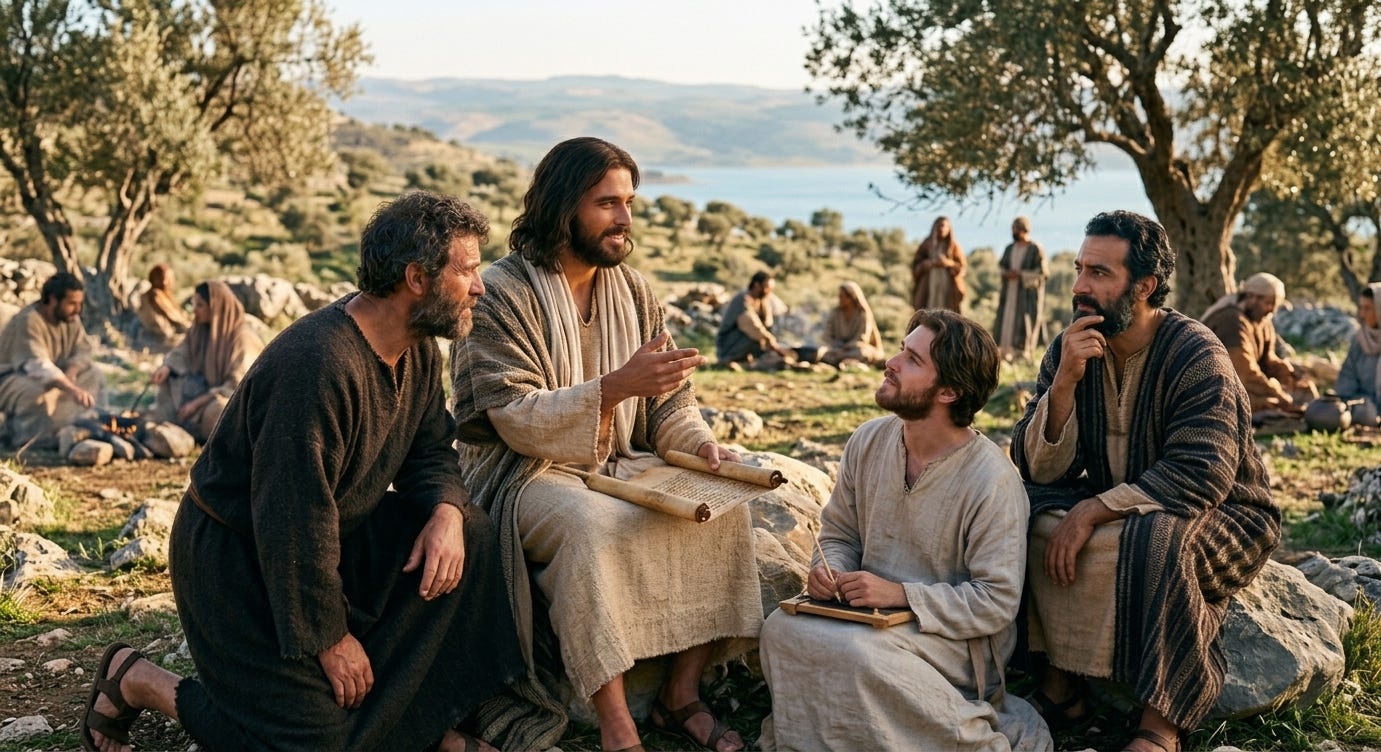
Read it again slowly, because it runs against nearly everything the last few decades of church culture trained us to believe.
We were taught to broadcast to the masses. Reach as many people as possible with the best message. Scale the platform. Grow the audience. Invest in systems that can handle exponential growth.
And to be clear, that instinct is not all bad. Jesus preached to thousands. Hebrews tells us not to forsake the assembling of ourselves together (Hebrews 10:25). Gathering matters!
But ask yourself an honest question: did the crowds change the world?
The five thousand ate the fish and went home.
The twelve were incredibly broken,
One betrayed Him
One denied Him
Most of them scattered when it got hard
But they turned the known world upside down inside a couple of generations.
So which one did Jesus bet on?
Think about the math for a second. If you invest deeply in two people this year, and they each invest in two next year, and that pattern holds, by year ten you have touched over a thousand people.
Not “touched” like a Sunday handshake.
Trained.
Equipped.
Multiplying.
Every one of them reproducing the same pattern in someone else.
That’s not a program. That’s a movement.
Now compare that to standing in front of a thousand people every single Sunday and preaching the most Christ-exalting sermon ever delivered. If those thousand people never reproduce a single disciple in their everyday lives, what do you actually have?
You have attendance, but not necessarily multiplication.
Which raises the real question of this whole series.
🎯 How Are We Keeping Score of Our Fruitfulness 🎯
The Obstacle We Have To Wrestle to the Ground
I want to be VERY CLEAR, because I love the local church in all its forms, and I am not throwing rocks at the form. Some of the most faithful people I have ever known are carrying loads inside big churches that I could not carry.
🚫 This is not an anti-church argument. It never has been.
But I have to ask an honest question.
What happens to a leader’s time when the church becomes a business?
Think about what it actually takes to run a 2,500-member organization. A multi-million-dollar building that has to be heated, cooled, insured, and paid down. A staff that has to be hired, managed, reviewed, and paid every two weeks. A weekend production that has to be planned, rehearsed, and pulled off at a high level fifty-two times a year.
💰Budgets.
👨🏻💼Boards.
📽️ Slide Decks.
📝 Liability.
None of that is sin. All of these are real-life issues.
And all of it quietly eats the one resource disciple-making needs most:
❤️🔥 More Time with Fewer People ❤️🔥
Here’s the trap that I’ve watched good men and women walk into with the best intentions. The bigger the container gets, the more of the leader’s life the container consumes, until the very people called to make disciples no longer have the margin to spend all of themselves on three, a lot of themselves on nine others, and some of themselves on seventy-two.
So we do the reasonable thing.
We delegate the depth. We professionalize the one-anothers. We build small groups inside the big group and hope the real thing happens somewhere down in there.
And I just want to gently ask: if the deep work has to happen in the small group anyway, what is all the machinery around it actually for?
Here’s the part that lands closest to home for most of us reading this, because most of us are not the pastor. We’re the everyday disciple with a job, a family, and a calendar that’s already full.
⛪️ What does the crowd model quietly ask of you?
It asks you to show up.
Attend.
Serve.
Volunteer.
Fill a slot.
And those aren’t bad things.
But be honest about what they cost. Every hour the machine asks of your limited margin is an hour you did not spend going deep with the two or three people in your own oikos, your relational web of neighbors, coworkers, family, and friends where you
🏠 live,
👩🏻🎓 learn,
📎 work,
⚽️ and play.
Ephesians 4 says the gathered church exists to equip the saints for the work of ministry. That’s a church sending people ➡ OUT into disciple-making, not just receiving people 🔄 IN for consumption. So here’s the question that haunts me for the ordinary believer:
🤔 Is your church spending your margin or sending your margin?
That’s not an accusation.
It’s a question I had to answer for my own life. What’s your honest answer?
You Can’t Get Jesus’ Results From a Not-Jesus Behavior
If we want the results of Jesus, we have to practice the principles of Jesus, walk in the behaviors of Jesus, and embrace the values of Jesus.
We love the results Jesus got. A movement that outlived Him, outran His calendar, and eventually crossed every border on earth. But those results came out of a method. More of Himself to fewer people, on purpose, for three years, with 🚫 no building, 🚫 no budget, and 🚫 no platform to protect.
So here’s the question underneath all my other questions:
Do we want His results badly enough to actually try His method?
I don’t think the answer is automatic, because His method costs something.
It’s slower.
It’s smaller.
It doesn’t photograph well.
There’s no stage, no lights, and nobody claps when you spend a Tuesday night pouring your life into three ordinary people who may never know your name is on a book.
But it multiplies.
And the crowd, for all its energy, mostly just stays a crowd.
You Can’t Score a Baseball Game on a Football Scoreboard
Can you imagine a baseball game being scored on a football scoreboard? Seven points is a completely different story depending on which game you’re watching. A touchdown means nothing on a diamond.
One is a 😬 NAIL-BITER, and the other is a 🤩 BLOWOUT!
That is why we feel like such failures when we try to measure a simple church with a megachurch scoreboard.
For decades, the primary metrics of church health have been the same three numbers: attendance, giving, and program participation.
Butts in seats.
Dollars in the plate.
Volunteers on the roster.
And those numbers are not worthless. They tell you something. A growing church often has real spiritual vitality. Generosity is a discipleship issue. Volunteerism reflects engagement.
But there’s a problem with making them your scorecard: you can hit every single one of those numbers and still have zero multiplication of actual disciples of Jesus Christ❗️
You can have a full parking lot and empty hearts.
You can have a packed weekend service and a generation of young adults walking out the back door for good.
You can have a growing budget and a shrinking Kingdom footprint.
I’ve watched it happen in churches I have loved. The scoreboard looks great on the surface while underneath it a movement has stalled. Jesus’ Great Commission was not “Go and fill auditoriums.” It was “Go and make disciples.”
So what would actually happen if we kept score of that?
Try measuring these instead:
✔ How many spiritual conversations did we have this week with people who aren’t yet following Jesus?
✔ Is each of us currently investing deeply in two or three people who are on a disciple-making journey?
✔ Have the people we’re investing in begun to invest in others?
✔ Are we praying, specifically and by name, for the people in our oikos who are far from God?
✔ Is anyone in our lives moving closer to Jesus because of our intentional presence?
Feel how different those questions are from “Did I attend enough this month?” They should feel different. They are scoring an entirely different game.
And here’s the quiet miracle of it: changing your scoreboard changes what you see. Start counting Kingdom multiplication instead of congregational participation, and you start noticing things you used to walk right past. The coworker who asks the unexpected question about faith. The neighbor going through a divorce who just needs someone to sit with her. The everyday moments God set up as your mission field all along.
❤️🔥 Change what you measure, and you change what you look for. Change what you look for, and you change how you live.
Helpful? Click the Button and Buy Me a Coffee.
So Let Me Leave You With Questions, Not a Verdict
I told you at the top I wasn’t here to win an argument. I meant it. I would rather you come to your own conclusions in the quiet than take mine on loan.
So deeply consider these for a minute:
Who got all of you last week? Your calendar already answered that one. Was it a few people, a crowd, or a machine?
What scoreboard have you been checking to feel like your spiritual life is “winning”? And where did you get that scoreboard in the first place?
If you genuinely wanted the results of Jesus, what would you have to stop doing to make room for His method?
You don’t have to blow anything up to answer these. You don’t have to quit your church this week. You just have to be honest about the game you’re actually playing, and the game Jesus played.
More time with fewer people produces greater results.
He gave everything to three.
A lot to nine others.
Some to seventy-two.
A little to the crowds.
And the crowd is the part we kept.
What would change if you flipped it?
✏️ In the comments, tell me: who are the two or three people you could start giving more of yourself to this week? First names only. Let’s pray for them together. 👇
If you want to learn more about Simple Church, prayer mapping, and the tools that make relational multiplication actually work, DM me or go to disciplemakingcollective.com!
Vanderbloemen - https://www.vanderbloemen.com/resources/healthy-church-budget-percentages/
Billy Graham was once asked, ‘If he had it to do again what might he change?’
His response was that he would gather 12 people and pour into them…release them to follow Jesus’ example.
Great word, bro.